
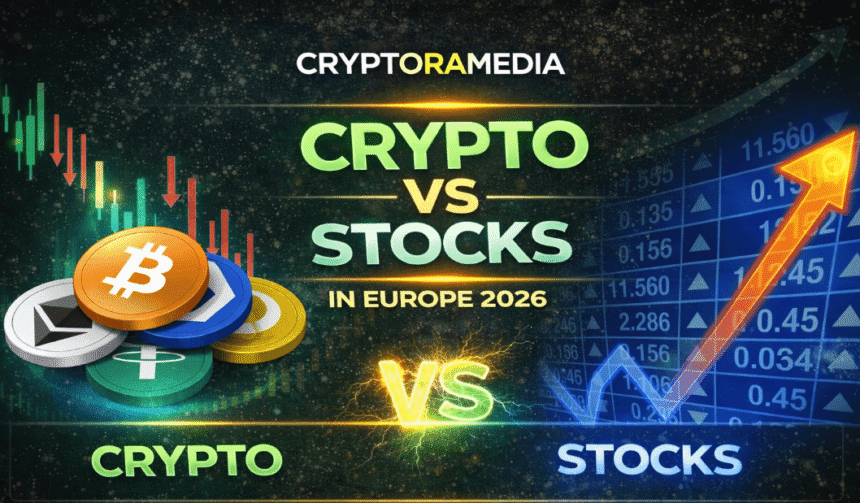
Crypto vs Stocks in Europe 2026 — Performance, Risk & Regulation Overview
| Quick Answer: There is no single answer but there is data. Over 10 years (2015–2025), Bitcoin’s annualised CAGR of approximately +44% dwarfs the S&P 500’s +13%. Yet in 2025 specifically, stocks won decisively: S&P 500 returned approximately +25% while Bitcoin ended the year at -7.96% despite hitting a $126,000 all-time high in October. Bitcoin’s Q4 leverage reset erased months of gains. The honest answer is: Bitcoin produces higher long-term returns with dramatically higher volatility and risk. Stocks produce steadier, more predictable compounding with regulatory protection. For most European investors, the optimal approach is both with allocation proportional to risk tolerance. This article presents 11 years of head-to-head return data, the full EU regulatory landscape (MiCAR changes everything from July 2026), a risk/return framework, and five portfolio allocation models. |
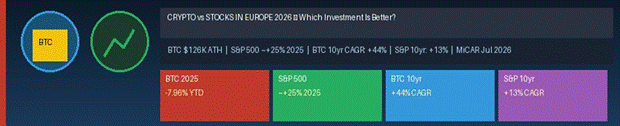
| BTC 10yr CAGR | S&P 500 10yr CAGR | 2025 Winner | MiCAR deadline |
| +44% — dwarfs all traditional assets | +13% — consistent, dividend-paying | S&P 500: +25% vs BTC: -7.96% YTD | July 2026 — unregulated EU exchanges must close |
The Headline Question: What Do 11 Years of Data Actually Show?
| Quick Answer: Bitcoin has outperformed every major traditional asset class over any 5+ year rolling window since 2015 including the S&P 500, EURO STOXX 50, gold, and government bonds. The 10-year CAGR comparison is Bitcoin +44% vs S&P 500 +13%. However, this outperformance comes with extreme year-to-year variability: Bitcoin has gained +1,331% in a single year (2017) and lost -72% in another (2018). The S&P 500’s worst year in this period was -18% (2022). European equities (EURO STOXX 50) delivered approximately 8-12% annually over the period with lower volatility than US stocks. The question is not which asset performed better historically Bitcoin did, clearly but whether the additional return justifies the dramatically different risk profile. |
| New to This? CAGR stands for Compound Annual Growth Rate the year-on-year growth rate that would produce the same end result if applied consistently every year. A 44% CAGR means that on average, compounded annually, Bitcoin produced 44% returns per year over 10 years. This is a mathematical average that conceals massive year-to-year swings: in reality, Bitcoin had years of +1,000%+ and years of -70%. The S&P 500’s 13% CAGR is far more consistent year-to-year. CAGR is useful for comparing long-term terminal wealth but tells you nothing about the stomach-turning volatility you would have experienced along the way. |
The comparison also reveals an important asymmetry in how returns are distributed. Bitcoin’s enormous 10-year CAGR is largely explained by its early-mover extraordinary returns: an investor who bought Bitcoin in 2015 at approximately $300 and held to 2025’s average price would have achieved a 35,000%+ return. An investor who bought in January 2021 (near the previous ATH) and held through 2025 has a modestly positive return but has endured two major 70%+ drawdowns. The entry point for crypto investments is enormously consequential in a way that stock index investing is not — dollar-cost averaging over time reduces this timing risk.
- The Headline Question: What Do 11 Years of Data Actually Show?
- Head-to-Head: Bitcoin vs S&P 500 vs EURO STOXX 50 — 2015 to 2025
- Understanding Bitcoin’s Specific Risk Profile
- Full Comparison: Crypto vs Stocks — 12 Dimensions Analysed
- The EU Regulatory Landscape: MiCAR Changes Everything From July 2026
- Portfolio Allocation Framework: Crypto + Stocks for European Investors
- Where to Actually Invest in Europe: Platforms for Both Asset Classes
- For Crypto (MiCAR-Licensed Platforms)
- For Stocks and ETFs
- The Honest 2026 Verdict: Crypto vs Stocks in Europe
- Frequently Asked Questions
European investors specifically face additional considerations that American investors do not. The EURO STOXX 50 has significantly underperformed the S&P 500 over the same 10-year period — partly due to the tech-sector deficit in European public markets, partly due to structural macroeconomic differences. A European investor comparing ‘stocks’ to crypto should compare against European index returns (~8-10% CAGR for EURO STOXX 50) rather than the S&P 500 benchmark — which makes crypto’s relative advantage even larger for European equity investors specifically.
Head-to-Head: Bitcoin vs S&P 500 vs EURO STOXX 50 — 2015 to 2025
| Year | Bitcoin Return | S&P 500 | EURO STOXX 50 | Winner | Context |
| 2015 | Bitcoin: +35% | S&P 500: +1.4% | EURO STOXX: +8% | BTC wins | Relatively quiet year for both. BTC modest recovery from 2014 lows |
| 2016 | Bitcoin: +125% | S&P 500: +12% | EURO STOXX: −1% | BTC wins | China crypto demand surge. European stocks weak on Brexit vote uncertainty |
| 2017 | Bitcoin: +1,331% | S&P 500: +22% | EURO STOXX: +7% | BTC dominant | Historic BTC bull run to $20K. Stocks healthy but irrelevant by comparison |
| 2018 | Bitcoin: −72% | S&P 500: −4% | EURO STOXX: −13% | Stocks win | BTC bear market. Stocks also down but massively outperform on relative terms |
| 2019 | Bitcoin: +95% | S&P 500: +31% | EURO STOXX: +24% | BTC wins | Strong year for all assets. BTC partial recovery rally after 2018 wipeout |
| 2020 | Bitcoin: +302% | S&P 500: +18% | EURO STOXX: −4% | BTC dominant | COVID year. BTC surged on institutional entry (MicroStrategy, PayPal). Stocks recovered; EU stocks lagged |
| 2021 | Bitcoin: +60% | S&P 500: +27% | EURO STOXX: +22% | BTC wins | Both performed well. BTC peaked at $69K. Stocks hit ATH on earnings growth and Fed support |
| 2022 | Bitcoin: −65% | S&P 500: −18% | EURO STOXX: −11% | Stocks win | Brutal year for both. Fed tightening crushed risk assets. FTX collapse amplified crypto losses. Stocks bad; crypto catastrophic |
| 2023 | Bitcoin: +155% | S&P 500: +24% | EURO STOXX: +16% | BTC dominant | BTC recovery driven by ETF anticipation. S&P strong on AI tech rally. EU stocks solid |
| 2024 | Bitcoin: +121% | S&P 500: +23% | EURO STOXX: +8% | BTC wins | Spot BTC ETF approval Jan 2024. Election year. Both performed strongly |
| 2025 | Bitcoin: −7.96% | S&P 500: ~+25% | EURO STOXX: ~+10% | Stocks win | BTC hit $126K ATH Oct then Q4 lever reset. S&P hit 6,900+ on AI/earnings. Stocks clear winner on YTD basis |
| 📊 Data Point: The data shows 7 years where Bitcoin outperformed stocks and 4 years where stocks outperformed Bitcoin over the 2015-2025 period. Bitcoin’s wins were typically larger in magnitude (100-1,300%+) than its losses (−65% to −72%). But the 2025 result stocks +25%, BTC -7.96% despite an ATH demonstrates that BTC’s outperformance is not guaranteed even in a Bitcoin ATH year. Timing, leverage positions, and macro conditions all affect the annual outcome. |
Risk vs Return: Where Each Asset Class Sits
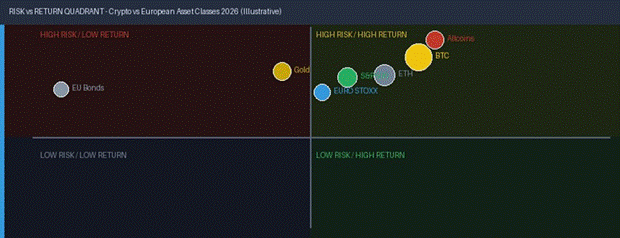
Risk vs Return Quadrant — Crypto vs European Asset Classes 2026 (Illustrative, not investment advice)
| Quick Answer: The risk/return map places Bitcoin and high-risk altcoins in the High Risk / High Return quadrant exactly where data places them. The S&P 500 and EURO STOXX 50 sit in the Low-Moderate Risk / Moderate-High Return quadrant. Government bonds and cash sit in the Low Risk / Low Return quadrant. Gold occupies a unique Low-Moderate Risk / Moderate Return space as an inflation hedge. The critical observation for European investors: BTC historically compensates for its high volatility with high returns, but only over long holding periods (5+ years). Over 1-2 year periods, BTC’s risk/return is unfavorable as 2025 demonstrated. |
Understanding Bitcoin’s Specific Risk Profile
Bitcoin’s risk profile is unlike traditional assets in several ways that matter for European investors. First, it trades 24/7 — meaning price moves can occur during weekends, holidays, and overnight hours when traditional risk management is unavailable. A 15% overnight BTC drop on a Saturday is possible and has occurred; a 15% S&P 500 drop overnight would be unprecedented and would trigger circuit breakers.
Second, Bitcoin’s volatility is partly leverage-driven — a significant portion of BTC price moves is amplified by derivatives positions being force-liquidated. The Q4 2025 example is instructive: Bitcoin fell from $126,000 to below $70,000 in roughly six weeks as leveraged long positions were force-liquidated in cascade. This represents not a change in Bitcoin’s fundamental value but a mechanics-driven price collapse. Users who held spot Bitcoin (no leverage) were temporarily down 44% but the underlying asset remained unchanged. Leveraged traders were wiped out.
Third, crypto’s correlation to traditional risk assets has increased as institutional participation has grown. In 2019-2020, Bitcoin showed low correlation to equities. In 2022 and 2025, it showed high correlation during risk-off events — falling alongside stocks when macro conditions deteriorated. This means crypto provides less diversification benefit than early adopters hoped, particularly in the specific periods when diversification is most needed.
| Expert Angle: The BTC-S&P 500 correlation dynamic in early 2026 is instructive for portfolio construction. As Bitcoin absorbed its Q4 2025 leverage reset (falling from $126K to below $70K), US equities stayed comparatively stable S&P 500 held above 6,400. This divergence is unusual and actually represents a best-case scenario for a mixed portfolio: crypto’s internal deleveraging was contained, equities held steady, and the correlation decoupled briefly. Investors with both asset classes in their portfolio outperformed those with crypto-only exposure during this period exactly the case for diversification. |
Full Comparison: Crypto vs Stocks — 12 Dimensions Analysed
| Dimension | Crypto | Stocks | Analysis & Context (Europe 2026) |
| Returns (10yr CAGR) | BTC: +44% | S&P 500: +13% | Bitcoin obliterated stocks on raw 10-year CAGR. But: BTC ended 2025 at -7.96% YTD from Jan price despite hitting $126K ATH. Annual returns are extremely non-linear 2019: +95%, 2022: -65% |
| 2025 Actual Returns | BTC: −7.96% YTD | S&P 500: ~+25% | Stocks won 2025 decisively at the index level. BTC hit $126K ATH in Oct then Q4 leverage reset wiped gains. Equity investors who stayed in index funds outperformed BTC holders by ~33% |
| Volatility (1yr) | BTC: 50–80% | S&P 500: 12–18% | BTC’s annualised volatility is 3-5x that of equities. A 30% BTC drawdown in a single month is routine; a 30% S&P 500 drawdown would be a historic crash. Volatility cuts both ways but most investors can’t stomach 50%+ drops |
| Liquidity | BTC: 24/7, global | S&P 500: Mkt hours | Crypto trades 24/7 including weekends and holidays a genuine advantage for portfolio management. Stock exchanges close evenings, weekends, and holidays. BTC can be liquidated any minute; blue-chip stocks cannot |
| Income yield | Crypto: 0% (base) | Stocks: ~1.5% div. | Stocks pay dividends; Bitcoin pays nothing. ETH staking yields ~3-4% but with platform commission reducing to ~2.5%. Dividend income from a total-return equity portfolio compounds meaningfully over 20+ year horizons |
| Minimum investment | Both: from €1 | MiCAR/MiFID II | Bitpanda, Trade Republic, Scalable Capital all offer €1 fractional investing across both asset classes. Barrier to entry is identical the difference is pure risk/return profile |
| Regulatory protection | Crypto: MiCAR (new) | Stocks: MiFID II (est.) | MiFID II is a 15+ year framework with investor compensation schemes. MiCAR is new (2024) strong in structure but untested in crisis. EU investor compensation covers stocks on licensed platforms up to €20K; crypto assets are excluded from these schemes |
| Tax treatment (EU) | Varies by country | Varies by country | Both subject to capital gains tax in most EU countries. Germany: crypto held >1 year is tax-free; stocks are not. Austria: 27.5% flat on both. France: 30% flat rate (PFU) on both. Tax treatment is a major decision factor consult a local tax advisor |
| Correlation to BTC | BTC: 1.0 | S&P 500: 0.3–0.5 | Crypto assets are highly correlated to each other (altcoins: 0.7-0.9 to BTC). Stocks have moderate correlation to BTC in risk-off events. This means crypto adds volatility to a portfolio but limited diversification during market crises |
| Custody / ownership | Self-custody possible | Must use a broker | Bitcoin can be withdrawn to a hardware wallet genuine self-sovereign ownership with no counterparty risk. Stocks are always held via a broker/custodian intermediary. This is philosophically significant and practically relevant in counterparty risk terms |
| Inflation hedge | Bitcoin: partial | Stocks: historical | Both have historically outpaced inflation over long periods. Bitcoin’s limited supply creates theoretical inflation resistance. Stocks hedge through earnings growth that tracks or exceeds inflation. Government bonds do not meaningfully hedge inflation; cash loses purchasing power |
| EU-specific regulation | MiCAR July 2026 | MiFID II ongoing | MiCAR creates a legal framework requiring any exchange serving EU users to hold a CASP licence. This is positive (establishes investor protection) but the July 2026 deadline will force platform consolidation and may disrupt access temporarily |
The EU Regulatory Landscape: MiCAR Changes Everything From July 2026
| Quick Answer: MiCAR (Markets in Crypto-Assets Regulation) is the most significant development in European crypto investing in 2026. The July 1 deadline requires all crypto exchanges serving EU users to hold a CASP (Crypto-Asset Service Provider) licence or stop operating. This creates three immediate implications: (1) unlicensed platforms must exit the EU market, which may disrupt access to some exchanges; (2) licensed platforms must hold 1:1 asset backing with ring-fenced client funds, legally equivalent to bank account protection; (3) the regulatory framework is now comparable in rigor to MiFID II for stocks, closing the regulatory gap that previously made stocks ‘safer’ from an investor protection standpoint. Early licensees: Bitstamp, Kraken, Coinbase, OKX, Bitpanda these are the exchanges to use in 2026. |
| Regulation | Scope | What It Means for European Investors |
| MiCAR (Markets in Crypto-Assets Regulation) | EU-wide, July 2026 deadline | The most important crypto regulation in European history. Requires all crypto exchanges serving EU users to hold a CASP licence from a national regulator. Enforces 1:1 asset backing, segregated client funds, disclosure requirements, and cybersecurity standards. After the July 2026 deadline, unlicensed platforms must cease EU operations. Early licensees: Bitstamp (Luxembourg), Kraken (Ireland), Coinbase (Luxembourg), OKX (Malta). Exchanges without licences will be blocked verify your platform’s status before July 2026 |
| MiFID II (Markets in Financial Instruments Directive) | EU-wide, established | The 15+ year-old framework governing European securities trading. Applies to stocks, ETFs, derivatives, and crypto platforms that offer regulated financial instruments. Provides investor compensation schemes (€20,000 per client), best execution requirements, and conflict-of-interest disclosures. Bitstamp holds a MiFID II MTF licence the same as European stock exchanges. Crypto assets themselves are not MiFID II instruments; only derivatives based on them fall under MiFID II scope |
| Investor compensation | Stocks: up to €20K | Under MiFID II, licensed stockbrokers must contribute to national investor compensation schemes protecting clients up to €20,000 if the broker becomes insolvent. Crypto assets under MiCAR do NOT receive equivalent scheme protection asset segregation requirements mean client funds should be ring-fenced, but insolvency recovery is not guaranteed by a compensation fund. This is a meaningful risk differential for large positions |
| Tax treatment EU | Both: CGT applies | Capital gains tax applies to profitable disposal of both crypto and stocks in all EU member states. Germany uniquely exempts crypto held for more than 1 year (no CGT). Austria and France apply a 27.5-30% flat rate to both. The Netherlands taxes unrealised wealth rather than gains (1.2% annual wealth tax). Always consult a local tax advisor the EU has no harmonised crypto tax standard and treatment varies significantly across member states |
| GENIUS Act (US impact on EU) | Indirect EU benefit | The US GENIUS Act (stablecoin legislation, signed July 2025) created legal certainty for dollar-backed stablecoins. While a US law, its effect on EU investors is significant: stablecoin market cap surged past $290B, making USDC and USDT more reliable on/off-ramp instruments. EU investors can now hold large stablecoin positions with greater confidence in the underlying legal framework of the dollar-denominated assets |
| Central Bank Digital Currencies | Digital Euro in development | The ECB’s digital euro project is in the preparation phase (2023-2026). A CBDC is not crypto. it is a digital form of the existing euro, fully controlled by the ECB, without the decentralisation properties of Bitcoin or Ethereum. Its existence will not replace Bitcoin or Ethereum but may reduce demand for stablecoins at the retail payments layer. Impact on investment crypto (BTC, ETH) is minimal |
| ⚠️ Risk Alert: Verify your crypto exchange’s MiCAR CASP licence status before July 2026. After the deadline, platforms without a CASP licence must cease serving EU users this means your assets could be frozen or access suspended if your exchange has not obtained the required licence. The safest approach: use only exchanges that already hold a MiCAR CASP licence today (Bitstamp, Kraken, Coinbase, OKX, Bitpanda). [See our Best Exchanges Europe Security 2026 guide internal link] |
Portfolio Allocation Framework: Crypto + Stocks for European Investors
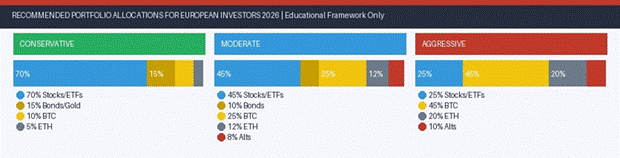
Portfolio Allocation Models for European Investors 2026 — Educational Framework Only, Not Financial Advice
| Quick Answer: The optimal portfolio allocation depends on time horizon, risk tolerance, and conviction level — not on which asset ‘wins’ in any given year. Five portfolio frameworks are presented: Conservative (10% BTC, 70% stocks/ETFs), Moderate (25% BTC + 10% ETH, 50% stocks), Aggressive (45% BTC + 15-20% ETH/Alts, 25-30% stocks), Crypto-First (60%+ crypto, 10-20% stocks), and Stocks-Only (valid choice for investors who prefer full regulatory protection and proven compounding). All crypto allocations should be on MiCAR-licensed platforms with self-custody for large holdings. |
| Investor Profile | Stocks / Bonds / Gold | Crypto Allocation | Risk Level | Strategy Rationale |
| Conservative EU Investor | 70% Stocks/ETFs 20% Bonds/Gold | 10% BTC 0% Alts | Low | Prioritise capital preservation and steady 10-12% long-term equity returns. Small BTC allocation as inflation hedge. Use Bitpanda or Trade Republic savings plans. Rebalance annually. No altcoins — volatility exceeds risk tolerance |
| Moderate EU Investor | 50% Stocks/ETFs 10% Bonds | 25% BTC 5-10% ETH | Moderate | Balanced growth portfolio. BTC as a meaningful allocation reflecting conviction in digital gold thesis. ETH for DeFi/revenue exposure. Use MiCAR-licensed platforms only. Quarterly rebalance. Consider DCA into crypto on volatility dips |
| Aggressive EU Investor | 25-30% Stocks/ETFs 0% Bonds | 45% BTC 15-20% ETH 5-10% Alts | High | Maximum crypto allocation consistent with still maintaining diversification. Stocks prevent total correlation to crypto bear markets. Alts only for investors with active management capacity. Strong risk management required — size positions so a 70% crypto drawdown is survivable |
| Crypto-First EU Investor | 10-20% Stocks/ETFs | 60%+ BTC 20-30% ETH/Alts | Very High | High-conviction crypto portfolio. Stocks/ETFs provide minimum diversification floor. Only suitable for investors who have studied crypto deeply, have high risk tolerance, and can absorb multi-year drawdowns of 60-80%. Not suitable as a retirement or emergency-fund portfolio |
| Stocks-Only EU Investor | 100% Stocks/ETFs (Index focus) | 0% Crypto | Low-Medium | Entirely valid strategy for investors who prefer not to engage with crypto complexity, volatility, or regulatory uncertainty. MSCI World + EURO STOXX 50 + EM allocation provides genuine global diversification. Expected 10-year return ~13% CAGR. No crypto complexity, no custody risk, no regulatory uncertainty |
| 💡 Key Insight: The most common European investor mistake in 2026 is treating crypto and stocks as mutually exclusive choices. The evidence strongly supports owning both stocks for steady compounding, dividends, and regulatory protection; Bitcoin for asymmetric upside, inflation hedging, and portfolio non-correlation during non-crisis periods. The specific allocation is a personal risk-tolerance decision. Even a 5% Bitcoin allocation in an otherwise traditional portfolio would have significantly improved total returns over the past 10 years while adding only marginal volatility to the overall portfolio. |
Where to Actually Invest in Europe: Platforms for Both Asset Classes
For Crypto (MiCAR-Licensed Platforms)
Bitpanda: Austria-based, MiCAR + MiFID II + FMA licensed. Best all-in-one for European investors — crypto + real stocks + ETFs + metals in one platform. Zero deposit/withdrawal fees. 650+ cryptos. [See our full Bitpanda Review 2026 — internal link]
Bitstamp: Luxembourg-based, MiCAR CASP + MiFID II MTF. Best EUR fiat rails (SEPA Instant), institutional-grade compliance, 15 years operating. 95% cold storage. Best for EUR-heavy conservative investors. [See our full Bitstamp Review 2026 — internal link]
Kraken: Ireland MiCAR licensed. Lower base fees (0.25%/0.40%), 200+ assets, user-verifiable Merkle-tree PoR, 50x futures for EU users. Best for crypto-first active traders seeking the gold standard in transparency.
Bitvavo: Netherlands-based, MiCA + DNB licensed. 0.15%/0.25% base fees — lowest among major EU exchanges. 350+ assets. Best for Dutch, Belgian, and German investors who prioritise fee minimisation.
For Stocks and ETFs
Trade Republic: €1 flat per stock/ETF trade. BaFin + MiFID II regulated. 8,000+ securities. Best pure cost-to-trade for regular equity investors in Germany/Austria/France/Netherlands.
Scalable Capital: 0% on prime plan, 8,000+ securities, automated portfolio management option. Best for hands-off index investors seeking a robo-advisory overlay alongside DIY trading.
Bitpanda Stocks: Real stock ownership from €1. Trade-free savings plans. MiFID II licensed. Best choice if you already use Bitpanda for crypto and want everything in one platform.
The Honest 2026 Verdict: Crypto vs Stocks in Europe
| 🏆 Verdict: Bitcoin wins on long-term raw return. Stocks win on risk-adjusted return, regulatory protection, dividend income, and consistency. The answer for most European investors in 2026 is both with the allocation determined by individual risk tolerance, investment horizon, and conviction in the digital asset thesis. The entry point for crypto matters enormously; the entry point for broad stock indices matters very little over 10+ year horizons. MiCAR compliance is now a non-negotiable filter for any crypto platform choice in Europe. And the July 2026 deadline makes platform selection an urgent decision, not a later one. |
The investor who bought Bitcoin in January 2021 and the investor who bought Bitcoin in January 2020 have had profoundly different experiences — despite holding the same asset. The S&P 500 investor who started in January 2021 and the one who started in January 2020 have had much more similar experiences — both are meaningfully up, with the 2020 investor only slightly ahead. This consistency is stocks’ core advantage. The higher average return is Bitcoin’s core advantage. Neither investor, in either scenario, is wrong.
For European investors specifically, the 2026 environment adds a unique tailwind for the ‘both’ strategy: MiCAR creates the legal clarity and investor protection infrastructure that was previously missing from European crypto, closing the regulatory gap that made stocks uniquely safe. Bitpanda’s launch of real stock ownership in January 2026 means European investors can, for the first time, build a properly diversified crypto + equity portfolio from a single MiCAR + MiFID II regulated platform. The infrastructure for the hybrid strategy now exists. The rest is allocation.
Frequently Asked Questions
Is crypto better than stocks in Europe in 2026?
It depends on your time horizon and risk tolerance. Over the past 10 years (2015-2025), Bitcoin’s annualised CAGR of approximately +44% far exceeded the S&P 500 (+13%) and EURO STOXX 50 (+8-10%). However, in 2025 specifically, European stocks won decisively: the S&P 500 returned approximately +25% while Bitcoin ended the year at -7.96% despite hitting a $126,000 all-time high in October. The Q4 leverage reset erased months of Bitcoin gains. The honest answer is that neither is objectively better — Bitcoin has produced higher long-term returns with dramatically higher volatility, while stocks produce steadier compounding with regulatory protection. Most financial advisors recommend a diversified portfolio containing both.
How much of my portfolio should be in crypto vs stocks?
There is no universally correct allocation — it depends on your age, risk tolerance, investment horizon, and financial goals. Common frameworks for European investors in 2026: Conservative (5-10% BTC, 70-80% stocks/ETFs, remainder in bonds/gold), Moderate (20-25% BTC + small ETH, 50-60% stocks), Aggressive (40-50% BTC, 15-20% ETH, 20-30% stocks). A stocks-only portfolio is entirely valid for investors who prefer not to engage with crypto’s volatility or regulatory complexity. The key principle: only allocate to crypto an amount that, if reduced to zero, would not materially harm your financial situation — crypto remains a high-risk asset class where total loss is theoretically possible.
What impact does MiCAR have on European crypto investors in 2026?
MiCAR (Markets in Crypto-Assets Regulation) is the most significant regulatory development for European crypto investors in 2026. Its July 1, 2026 deadline requires all crypto exchanges serving EU users to hold a CASP (Crypto-Asset Service Provider) licence from a national EU regulator. After this deadline, unlicensed platforms must cease EU operations — meaning access to unregulated exchanges could be blocked and assets potentially frozen during transition. Practically: verify your exchange holds a MiCAR CASP licence before July 2026. Currently licensed: Bitstamp (Luxembourg), Kraken (Ireland), Coinbase (Luxembourg), OKX (Malta), Bitpanda (Austria). MiCAR also requires 1:1 asset backing and client fund segregation — legal protections that significantly reduce the risk of FTX-style insolvency events for EU users.
How are crypto gains taxed in Europe?
Crypto capital gains taxation varies significantly across EU member states — there is no harmonised EU standard. Germany: crypto held for more than 12 months is entirely tax-free (no capital gains tax on long-term holdings). Austria: 27.5% flat rate (Kapitalertragsteuer) on all crypto gains, applied equally to stocks. France: 30% flat rate (Prélèvement Forfaitaire Unique / PFU) on both crypto and stock gains. Netherlands: unrealised wealth tax of approximately 1.2% annually on net assets above €57,000, regardless of whether assets are sold. Spain: tiered capital gains tax from 19% to 28%. Always consult a local tax advisor — the specific rules for when a taxable event occurs (swap, staking rewards, DeFi transactions) are complex and country-specific.
Did stocks or crypto perform better in 2025?
Stocks outperformed crypto significantly in 2025 at the index level. The S&P 500 returned approximately +25%, the EURO STOXX 50 approximately +10%. Bitcoin started 2025 at approximately $93,600, reached an all-time high of $126,000 in October 2025, but ended the year at approximately $88,400 — a -7.96% return year-on-year from the January 1 starting price. The defining event was the Q4 leverage reset: Bitcoin fell nearly 30% from its October high in approximately six weeks as over-leveraged long positions were force-liquidated. Ethereum underperformed even more severely at approximately -15% for the year. However, this was consistent with 2025 being the 4th year of Bitcoin’s 4-year cycle — historically the weakest year. The 2025 result does not predict 2026 performance in either direction.
Can I buy both crypto and stocks on the same European platform?
Yes — Bitpanda is the leading European platform offering genuine one-stop investing across crypto (650+ assets), real stocks and ETFs (10,000+ securities, launched January 2026), physical precious metals, and EUR savings products. It holds MiCAR + MiFID II + FMA (Austrian) licences and is available across Europe. Trade Republic and Scalable Capital offer stocks/ETFs at lower fees but have limited or no crypto. Kraken and Bitstamp offer superior crypto features but do not offer equities. For investors who want the simplest possible multi-asset European portfolio, Bitpanda is currently the only fully integrated option. [See our full Bitpanda Review 2026]