

95.24% of all Bitcoin that will ever exist is now in circulation. Only 1 million BTC remain — and they’ll take 114 years to mine. Foundry USA mined the historic 20 millionth coin at block height 939,999 on March 9, 2026. This is what it means for scarcity, price, and the future of BTC.
- What Actually Happened on March 9, 2026?
- Bitcoin’s Supply: How Full Is the Tank?
- The Halving Schedule: Why Supply Slows to a Crawl
- 17 Years to 20 Million: A Timeline of Milestones
- Does Bitcoin’s 20 Million Milestone Drive the Price Up?
- What Happens When All 21 Million Bitcoin Are Mined?
- Bitcoin vs Gold: Which Is Truly Scarcer?
- Crypto Tax & Bitcoin Supply FAQ
- 5 Things to Remember About Bitcoin’s 20 Million Milestone
THE NUMBERS AT A GLANCE
| ₿ 20,000,000+ Bitcoin Mined So Far As of March 9, 2026 | 🏆 95.24% % of Total 21M Supply All that will ever circulate |
| ⏳ ~1,000,000 Remaining BTC to Mine Takes 114 years at current rate | 📅 Year 2140 Last Bitcoin Estimated Due to exponential halving schedule |
| 🔥 2.3–3.7M BTC Permanently Lost Forgotten keys & burned addresses | ⚡ ~450 BTC Daily New BTC Issued Since April 2024 halving |
— THE HISTORIC MOMENT
What Actually Happened on March 9, 2026?
On March 9, 2026, the Bitcoin network quietly crossed one of the most significant thresholds in its 17-year history. At block height 939,999, Foundry USA — one of the world’s largest Bitcoin mining pools — successfully mined what became the 20 millionth Bitcoin ever created.
| ⛏ Block Detail: Block Height: 939,999 | Miner: Foundry USA Pool | Reward: 3.125 BTC | Date: March 9, 2026 |
The moment was 17 years, two months, and one week in the making — stretching back to January 3, 2009, when Satoshi Nakamoto mined Bitcoin’s very first block, the Genesis Block, with a reward of 50 BTC.
| ““ With 20 million coins, that gives each coin a value of about $10 million. — Hal Finney, Bitcoin pioneer — writing in 2009 |
Finney’s 2009 prediction was dismissed as fantasy. Today, with only 1 million BTC left to ever be mined and institutional capital flooding in, it reads more like foresight.
— BITCOIN SUPPLY VISUAL
Bitcoin’s Supply: How Full Is the Tank?
Think of Bitcoin’s 21 million supply cap like a finite tank of water. Here’s where we stand:
| Bitcoin Supply Progress ████████████████████░ 95.24% Mined ■ 20,000,000 BTC mined □ ~1,000,000 BTC remaining (4.76%) |
But here’s the twist: of the 20 million already mined, an estimated 2.3 to 3.7 million BTC are gone forever — lost to forgotten passwords, discarded hard drives, and wallets belonging to early adopters who have since died. The effective liquid supply is significantly smaller than 20 million.
| 💡 Key Insight: If you subtract lost coins, the real accessible supply could be as low as 16–17 million BTC. That makes Bitcoin considerably rarer than the headline number suggests. |
— BITCOIN HALVING SCHEDULE
The Halving Schedule: Why Supply Slows to a Crawl
Bitcoin’s supply isn’t released at a constant rate. Every 210,000 blocks — roughly every four years — the reward paid to miners is cut in half. This ‘halving’ event is built directly into Bitcoin’s source code by Satoshi Nakamoto and cannot be changed without a consensus of the entire network.
| Halving # | Year | Block Reward | Daily BTC | BTC Mined | Status |
| Genesis | 2009 | 50 BTC | 7,200 BTC | 0 → 10.5M | ✅ Complete |
| 1st Halving | 2012 | 25 BTC | 3,600 BTC | 10.5M → 15.75M | ✅ Complete |
| 2nd Halving | 2016 | 12.5 BTC | 1,800 BTC | 15.75M → 18.375M | ✅ Complete |
| 3rd Halving | 2020 | 6.25 BTC | 900 BTC | 18.375M → 19.6M | ✅ Complete |
| 4th Halving | 2024 | 3.125 BTC | 450 BTC | 19.6M → 20M+ | 🟠 Current |
| 5th Halving | 2028 | 1.5625 BTC | 225 BTC | → ~20.4M | ⏳ Upcoming |
| Final Block | ~2140 | ~0 BTC | < 1 BTC/day | → 21,000,000 | 🔮 Projected |
The mathematical elegance of this design is striking:
- It took 17 years to mine the first 20 million Bitcoin
- The final 1 million will take 114 years due to the halving schedule
- By the 2040s, daily BTC issuance will fall below 30 BTC per day
- By the 2060s, the figure drops below 2 BTC per day
- The last full Bitcoin is expected sometime in the 2090s
- The very last satoshi (0.00000001 BTC) follows around 2140
— BITCOIN’S JOURNEY
17 Years to 20 Million: A Timeline of Milestones
| 2009 | Genesis Block Mined Satoshi Nakamoto mines the first block. Reward: 50 BTC. Bitcoin had zero market value. |
| 2010 | First Real Transaction 10,000 BTC is spent on two pizzas — establishing Bitcoin’s first real-world price (~$0.001 per BTC). |
| 2012 | 1st Halving Block reward drops from 50 BTC to 25 BTC. Supply: ~10.5 million. Bitcoin price: ~$12. |
| 2016 | 2nd Halving Block reward drops to 12.5 BTC. Supply: ~15.75 million. Bitcoin price: ~$650. |
| 2020 | 3rd Halving Block reward drops to 6.25 BTC. Supply: ~18.375 million. Bitcoin price: ~$9,000. Institutional adoption begins. |
| 2024 | 4th Halving Block reward drops to 3.125 BTC. Daily issuance: 450 BTC. First Bitcoin ETFs approved in the US. |
| 2026 | 20 Million Mined ★ Historic milestone. Foundry USA mines the 20 millionth Bitcoin at block 939,999. 95.24% of supply complete. |
| 2028 | 5th Halving (Projected) Block reward will drop to 1.5625 BTC. Daily issuance: ~225 BTC. Supply scarcity intensifies. |
| 2140 | Final Bitcoin The last fractions of Bitcoin are mined. All future miner income comes entirely from transaction fees. |
— SCARCITY & PRICE IMPACT
Does Bitcoin’s 20 Million Milestone Drive the Price Up?
The relationship between Bitcoin’s supply milestone and its price is real — but it is not simple. Here’s an honest breakdown:
The Bullish Case for Scarcity
- Basic economics: Demand rising + Supply fixed = Upward price pressure
- ETF inflows: US Bitcoin ETFs now hold billions in BTC, creating consistent institutional demand
- Accumulation outpaces issuance: Smaller holders accumulated ~19,300 BTC/month in 2025 vs only ~13,500 new BTC issued
- Supply deficit: Net accumulation exceeds new supply by over 40%, creating a mathematical squeeze
- Lost coins: Permanently lost BTC further shrinks real supply, compounding scarcity
The Counterarguments
- Macro conditions dominate: Geopolitical risk, interest rates, and liquidity can overpower supply fundamentals
- Scarcity is not new: Bitcoin’s fixed supply has been known since 2009. Markets may have priced this in
- Miner pressure: Post-halving, miners earn less and may sell BTC holdings to cover costs, adding supply pressure
- JPMorgan’s mining cost estimate: ~$77,000 production cost — miners face financial strain below this level
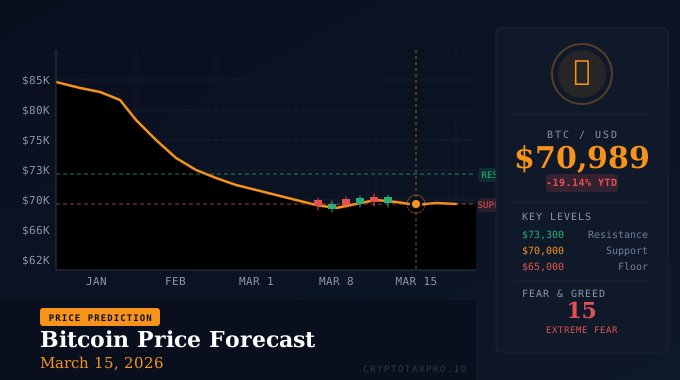
| 📊 Market Sentiment: As of March 2026, Bitcoin has declined ~20% year-to-date despite the milestone. Macro uncertainty is outweighing scarcity fundamentals in the short term — but long-term holders are accumulating aggressively. |
— THE ROAD TO 21 MILLION
What Happens When All 21 Million Bitcoin Are Mined?
When the last Bitcoin is mined around 2140, the network does not stop. Here’s what changes — and what stays the same:
| ✅ What Stays the Same • Bitcoin transactions continue normally • The blockchain keeps recording blocks • Miners still validate transactions • Network security maintained • 21M hard cap permanently enforced | 🔄 What Changes • No new Bitcoin created — ever • Miners earn only transaction fees • Fee market becomes critical for security • Inflation rate drops to absolute zero • Bitcoin becomes purely deflationary |
The key open question is whether transaction fees alone will adequately incentivise miners to keep securing the network after block subsidies disappear. This is one of the most important unresolved debates in Bitcoin’s long-term future.
— BITCOIN VS GOLD: THE SCARCITY COMPARISON
Bitcoin vs Gold: Which Is Truly Scarcer?
| Metric | ₿ Bitcoin | 🥇 Gold |
| Supply Cap | Hard cap: 21 million BTC | No hard cap — mining continues |
| Annual Inflation | < 0.9% (post-2024 halving) | ~1.5–2% from new mining |
| Verifiability | Any node can verify instantly | Requires assay & physical audit |
| Portability | Send anywhere in 10 min | Heavy, costly to transport |
| Divisibility | Down to 0.00000001 BTC | Physical division impractical |
| Supply Growth | Fixed & mathematically known | Unknown — new deposits found |
| Lost Supply | 2.3–3.7M BTC lost forever | Recycling keeps gold in circulation |
Bitcoin’s inflation rate is now below 0.9% — lower than gold (~1.5–2%), the US dollar’s 2% target, and every major fiat currency on Earth. At the 5th halving in 2028, Bitcoin’s inflation rate will drop below 0.45%.
More Read

Crypto Tax & Bitcoin Supply FAQ
How many Bitcoin have been mined so far?
As of March 2026, over 20 million Bitcoin have been mined — representing 95.24% of the total 21 million supply cap. At block height 939,999, Foundry USA mined the historic 20 millionth coin. Only approximately 1 million BTC remain to be issued.
When will the last Bitcoin be mined?
The last Bitcoin is projected to be mined around the year 2140. This is due to Bitcoin’s halving mechanism, which cuts the block reward in half every ~4 years. The schedule is hardcoded into Bitcoin’s protocol and exponentially slows new supply over time.
What happens when all 21 million Bitcoin are mined?
After all 21 million Bitcoin are mined, no new BTC will be created. Miners will earn income solely from transaction fees. The Bitcoin network will continue to operate, process transactions, and maintain security as normal — but the inflation rate will drop to absolute zero.
How much Bitcoin is lost forever?
Between 2.3 million and 3.7 million BTC are estimated to be permanently lost, according to blockchain analytics firms River Financial and Chainalysis. These are coins in wallets with forgotten or destroyed private keys — they can never be recovered, making the real accessible supply much smaller.
What is Bitcoin’s current inflation rate?
Bitcoin’s annual inflation rate is currently below 0.9% following the April 2024 halving. Only approximately 450 new BTC are issued per day. This makes Bitcoin’s supply growth rate lower than gold (~1.5–2%) and far below any major fiat currency.
Who mined the 20 millionth Bitcoin?
The 20 millionth Bitcoin was mined by Foundry USA, one of the world’s largest Bitcoin mining pools, at block height 939,999 on March 9, 2026. The block reward earned was 3.125 BTC, the current level set by the April 2024 halving.
Does the 20 million milestone mean Bitcoin’s price will go up?
The scarcity milestone is bullish for Bitcoin’s long-term outlook — accumulation already outpaces new issuance by over 40%. However, short-term price is driven by macro conditions, risk sentiment, and liquidity. As of March 2026, Bitcoin has declined ~20% year-to-date despite the historic supply milestone.
Can Bitcoin’s 21 million supply cap be changed?
Technically, changing the 21 million cap would require consensus from the overwhelming majority of Bitcoin’s full node operators globally. In practice, this is considered effectively impossible — the 21 million cap is Bitcoin’s most sacred property, and any attempt to change it would likely cause a chain split, destroying the legitimacy of the modified version.
— KEY TAKEAWAYS
5 Things to Remember About Bitcoin’s 20 Million Milestone
| 01 | 95.24% is already done Over 20 million of Bitcoin’s 21 million total supply has been mined. Only 1 million BTC — just 4.76% — remain, and they will take 114 years to issue. |
| 02 | The effective supply is even smaller Between 2.3 and 3.7 million BTC are permanently lost. The real accessible, liquid supply is likely 16–18 million BTC — not 20 million. |
| 03 | Scarcity is intensifying, not static Each halving cuts daily issuance in half. By 2028, only 225 BTC will be issued per day. By the 2040s, it will be fewer than 30. Supply is tightening exponentially. |
| 04 | Miners will eventually rely only on fees As block subsidies shrink toward zero, Bitcoin’s security model shifts to transaction fee revenue. Whether this is sufficient long-term remains the network’s biggest open question. |
| 05 | This milestone is historically unprecedented No other monetary asset in human history has a publicly known, mathematically fixed, cryptographically enforced supply cap. Bitcoin’s 20 million milestone is genuinely unique. |