
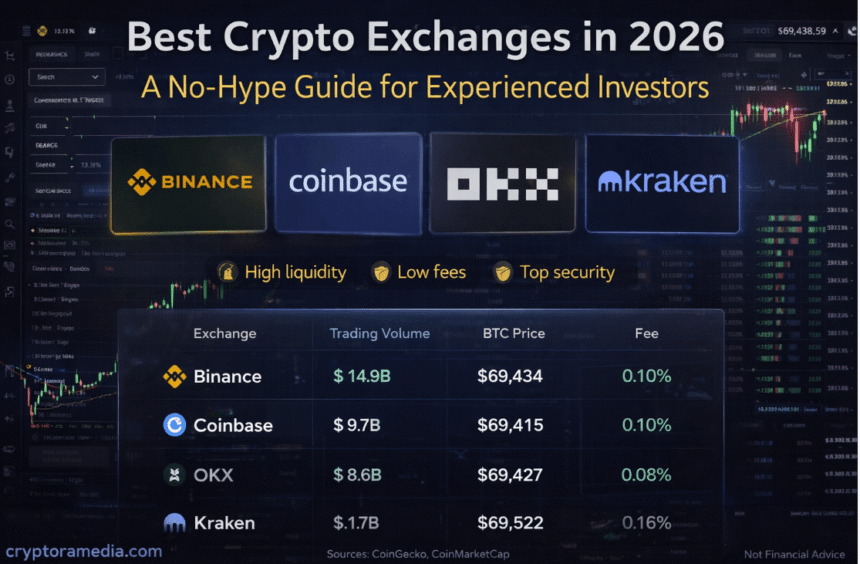
we will cover Best Crypto Exchanges in 2026 in the article .The crypto exchange landscape in 2026 looks nothing like it did five years ago. What began as a handful of scrappy platforms operating in regulatory grey zones has evolved into a multi-trillion-dollar global infrastructure, where billions in spot and derivatives volume move daily across platforms that are increasingly regulated, institutionally backed, and feature-rich.
- 1. Binance — The Volume King That Refuses to Be Dethroned
- 2. Coinbase — The Trust Play for U.S. Investors and Institutions
- 3. Kraken — The Security-First Veteran That Keeps Getting Better
- 4. OKX — The Global Derivatives Powerhouse Expanding into DeFi
- 5. Bybit — The Derivatives Specialist Becoming a Full Financial Platform
- 6. Gate.com (formerly Gate.io) — For Altcoin Hunters Who Know What They’re Doing
- 7. MEXC — The Lowest Fee Option for High-Frequency Spot Traders
- FAQ for Best Crypto Exchanges in 2026
But with that growth comes noise. Marketing budgets have ballooned, celebrity endorsements are everywhere, and new exchanges still launch every few weeks promising to be ‘the best.’ If you’ve been trading long enough, you know better than to trust the hype.
This guide cuts through all of it. We’ve evaluated the top platforms across the metrics that actually matter to experienced investors: regulatory standing, fee structures, liquidity depth, derivatives offerings, security track records, and how each exchange has evolved heading into 2026. Whether you’re managing a diversified crypto portfolio, actively trading perpetual futures, or exploring DeFi integrations from within a CEX, this breakdown is for you.
| Quick Take: The top three all-around platforms in 2026 remain Binance, Coinbase, and Kraken. But depending on your strategy — derivatives, altcoin hunting, DeFi access, or institutional-grade tools — there’s a clear best choice for each use case. |
What to Look for in a Crypto Exchange in 2026
Before we dive into individual platforms, it’s worth grounding our criteria. The factors that matter for a casual buyer differ significantly from what an experienced trader should prioritize. Here’s the framework we used:
Regulatory compliance and jurisdictional reach. With global crackdowns continuing and MiCA fully in effect across Europe, being licensed matters more than ever. Exchanges operating under legitimate oversight are less likely to freeze assets, exit-scam, or face sudden shutdown.
Fee structure beyond the headline number. A 0.10% spot fee sounds cheap until you account for funding rates on perpetuals, withdrawal fees, and spread manipulation. We’ve looked at the full cost of trading, not just the marketing rate.
Liquidity depth, not just volume. Wash trading is rampant across smaller exchanges. We focus on order book depth at the 1% and 2% slippage levels, particularly for mid-cap altcoins where liquidity gaps can erode profits.
Security infrastructure. Proof-of-reserves audits, cold storage ratios, two-factor authentication enforcement, and historical breach response. A platform that has been hacked and recovered responsibly often has stronger systems than one that simply hasn’t been tested yet.
Product breadth for advanced traders. Spot trading is table stakes. We care about perpetuals, options, structured products, staking yields, copy trading, and whether the platform is building toward becoming a full financial layer.
The Top Crypto Exchanges in 2026: At a Glance
| Exchange | Best For | Spot Fees | Derivatives | # of Assets | Regulation |
| Binance | Volume traders, altcoins | 0.10% (up to -25% w/ BNB) | Yes (125x) | 350+ | Multi-jurisdiction (partial) |
| Coinbase | US compliance, institutions | 0.00-0.60% (Advanced) | Limited | 250+ | SEC-regulated, NASDAQ listed |
| Kraken | Security-first, regulated | 0.00-0.26% (Pro) | Yes (50x) | 300+ | FCA, FinCEN, MiCA |
| OKX | DeFi + derivatives hybrid | 0.08% maker / 0.10% taker | Yes (125x) | 350+ | MiCA, VARA, US expanding |
| Bybit | Derivatives specialists | 0.02% maker / 0.055% taker | Yes (100x) | 500+ | VARA (Dubai) |
| Crypto.com | Rewards + retail crossover | 0.075% base | Limited | 400+ | Multiple regions |
| Gate.io / Gate.com | Altcoin depth, DeFi | 0.20% base | Yes | 1,700+ | Limited, improving |
| MEXC | Lowest fees, new tokens | 0% maker / 0.05% taker | Yes | 1,500+ | Limited |
Exchange Deep Dives
1. Binance — The Volume King That Refuses to Be Dethroned
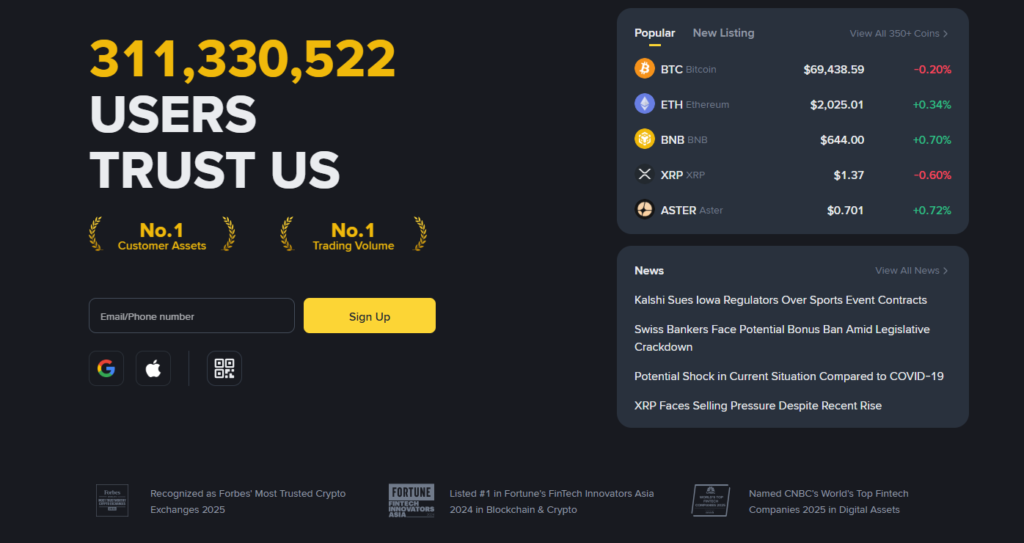
Binance remains the largest crypto exchange in the world by trading volume. By virtually any liquidity metric — order book depth, daily spot turnover, open interest in perpetuals — it leads the pack by a margin that no competitor has meaningfully closed. For experienced traders who live and die by execution quality on large positions, that matters enormously.
Binance processed over $217 billion in spot and futures markets daily at its 2025/2026 peak. That raw liquidity translates to tighter spreads on mid-cap altcoins, better fills on large orders, and a derivatives ecosystem that is simply unmatched in depth.
On fees, Binance charges 0.10% on spot trades for standard users, with discounts of up to 25% for paying fees in BNB. High-volume VIP tiers push those rates even lower. For derivatives, perpetual futures fees start at 0.02% maker and 0.05% taker — among the most competitive globally.
| Expert Angle: Binance’s biggest risk factor in 2026 isn’t its product — it’s regulatory. The platform is navigating compliance challenges across multiple jurisdictions simultaneously. Savvy traders keep significant holdings off-exchange regardless of which platform they use, but this point matters more with Binance than almost anyone else. |
That said, Binance’s regulatory posture has improved. The platform has paid fines, hired compliance leadership, and is actively pursuing licensing across more jurisdictions. It’s still not fully licensed in major Western markets the way Coinbase or Kraken are, but the trajectory is positive.
Where Binance stands out most in 2026 is product breadth. Beyond spot and futures, it offers options, staking, a full NFT marketplace, launchpad for new tokens, and Binance Pay for crypto payments. If you want everything in one ecosystem, nothing else quite compares.
2. Coinbase — The Trust Play for U.S. Investors and Institutions
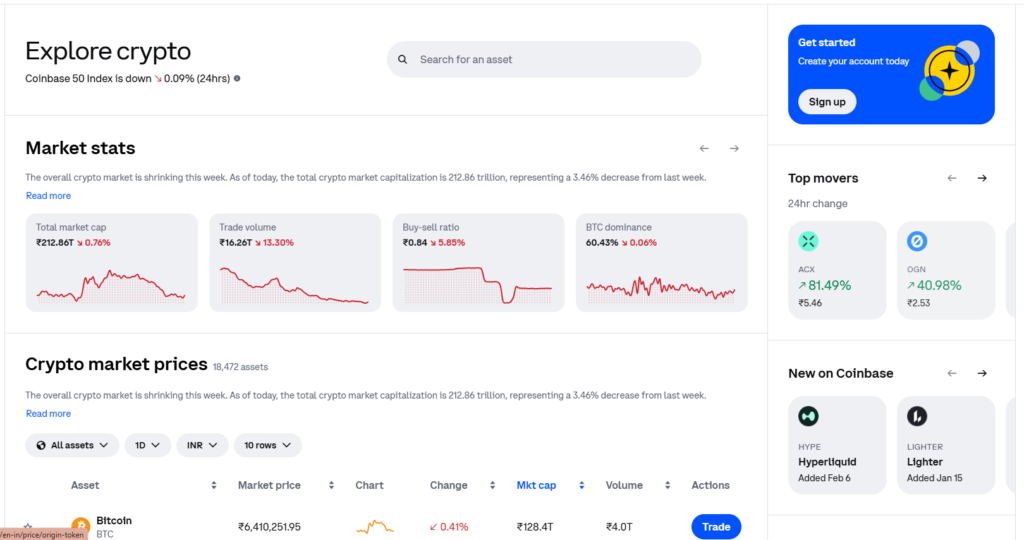
Coinbase occupies a unique position in the 2026 landscape. While it lacks the raw trading volume of Binance or the derivatives depth of Bybit, it offers something those platforms cannot: the deepest trust profile of any major exchange operating in the United States, backed by public company reporting obligations and SEC oversight.
The exchange manages approximately $516 billion in assets and serves millions of users. CEO Brian Armstrong’s vision for 2026 is bold — transforming Coinbase into an ‘everything exchange’ that merges crypto, equities, prediction markets, and commodities on a single platform. The exchange has already introduced tokenized stocks and prediction markets, allowing 24/7 trading of traditional assets on the blockchain.
Coinbase also operates Base, a Layer 2 blockchain built on Ethereum’s technology, which is rapidly becoming a DeFi hub with real developer adoption. And its co-issued USDC stablecoin with Circle gives it infrastructure reach that most exchanges simply don’t have.
Fee note: Coinbase’s Simple Trade interface is expensive — fees range from 1.49% for bank transfers to 3.99% via card. If you’re not using Coinbase Advanced Trade, you’re significantly overpaying. Advanced Trade uses a maker-taker model with fees from 0.00% to 0.60% depending on volume, which is competitive.
| Expert Angle: Coinbase is the exchange to use if you’re managing institutional capital, holding significant USD-denominated positions, or operating in a compliance-sensitive environment. For pure trading efficiency, however, Kraken Pro or Bybit will likely serve experienced traders better. |
3. Kraken — The Security-First Veteran That Keeps Getting Better
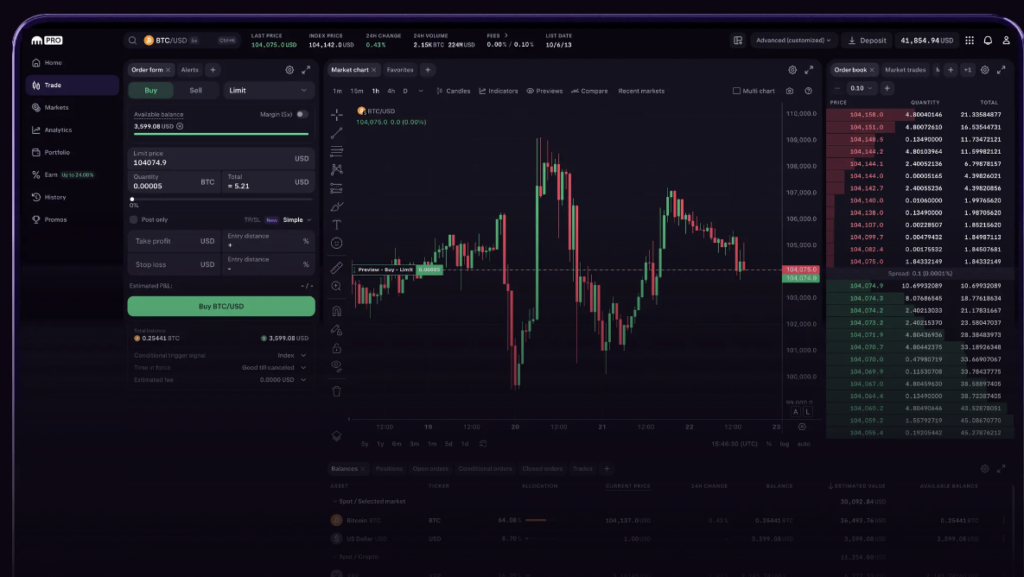
Kraken is the closest thing crypto has to a legacy institution. Founded in 2011, it has never been significantly hacked — a track record that is extraordinary given the industry’s history. In an environment where exchange failures and security breaches have wiped out billions in user funds, that track record is genuinely worth paying attention to.
Independent reviewers including Kaiko and CoinGecko consistently rank Kraken among the top global exchanges. And in 2026, Kraken has continued evolving without sacrificing its core identity. The platform supports over 300 cryptocurrencies and seven fiat currencies, offering one of the broadest fiat on/off-ramp networks in the industry.
Kraken Pro offers advanced charting connected to TradingView, sophisticated order types, and a derivatives platform with up to 50x leverage on major pairs. Fees on Kraken Pro range from 0.00% to 0.26% depending on volume — highly competitive for a regulated Western exchange.
Where Kraken differentiates in 2026 is its approach to regulatory compliance. It holds licenses with the FCA in the UK, FinCEN in the US, and operates under MiCA guidelines in Europe. For investors who prioritize platform longevity and regulatory certainty, Kraken is arguably the most defensible choice available.
4. OKX — The Global Derivatives Powerhouse Expanding into DeFi
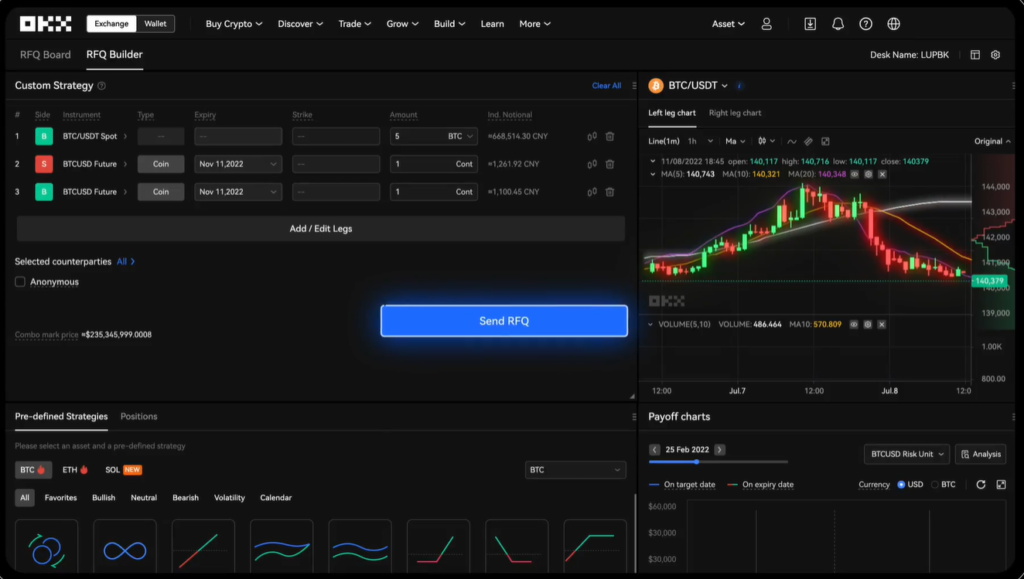
OKX has repositioned itself aggressively in 2026 as not just a trading platform but a full financial layer for crypto. Headquartered in Seychelles with a new regional office opening in San Jose, California, OKX now holds MiCA regulatory approval in Malta, a VARA license in Dubai, and is actively pursuing US expansion.
The platform supports over 350 digital assets across spot and derivatives markets, with perpetual futures offering up to 125x leverage. Its fee structure is tiered — maker fees starting at 0.08% and taker at 0.10% — with further discounts for high-volume traders or OKB token holders.
What makes OKX particularly interesting in 2026 is its Web3 wallet integration. Directly within the exchange app, users can access a DEX aggregator, NFT marketplace, DeFi protocols, and an on-chain staking interface. The line between CEX and DeFi is blurring on OKX faster than on any other major platform.
In 2026, OKX also announced an expansion into tokenized stocks and real-world assets, following a similar trajectory to Coinbase. The exchange publishes proof-of-reserves reports regularly — an important transparency signal that still sets it apart from some competitors.
5. Bybit — The Derivatives Specialist Becoming a Full Financial Platform
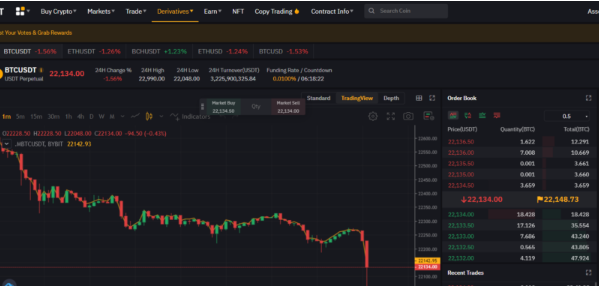
Bybit serves over 80 million users and is one of the largest derivatives exchanges globally. Based in Dubai and holding a VARA license, the exchange has built its reputation around professional-grade futures and perpetuals trading, with some of the tightest spreads on major pairs in the market.
Maker fees of 0.02% and taker fees of 0.055% make Bybit one of the lowest-cost options for active derivatives traders. The platform also offers spot markets and has expanded into a TradFi product suite called Bybit TradFi, targeting 500 trading pairs covering stock CFDs, forex, commodities, and indices.
Perhaps most notably, Bybit launched MyBank in 2026 — dedicated accounts designed to facilitate cross-border payments in 18 different fiat currencies, signaling a clear intent to compete as a full-spectrum financial institution rather than just a crypto exchange.
The platform has also invested in AI, releasing TradeGPT — an assistant designed to help traders navigate both crypto and forex markets. While AI trading tools vary wildly in quality across the industry, Bybit’s implementation has received reasonably positive feedback from its active user base.
| Expert Angle: Bybit is the top pick for derivatives-focused traders who want deep liquidity, low fees, and a platform that’s actively expanding its product suite. Its regulatory standing (VARA license in Dubai) is legitimate but narrower than Kraken or Coinbase, so position sizing considerations apply. |
6. Gate.com (formerly Gate.io) — For Altcoin Hunters Who Know What They’re Doing
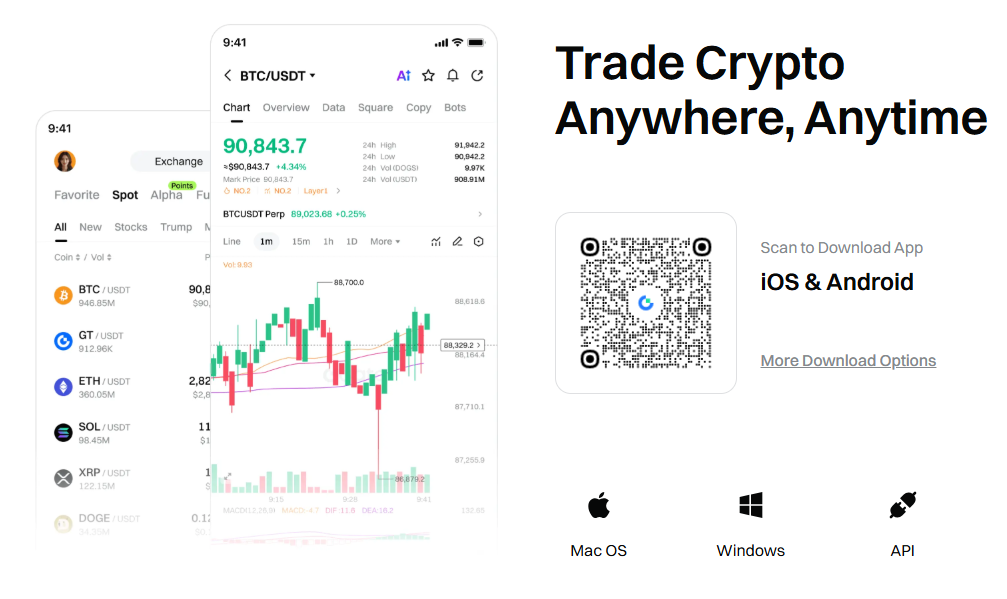
Gate.io underwent a significant rebrand in 2025/2026, transitioning to the more globally recognizable Gate.com. The platform has been operational since 2013 and supports an extraordinary breadth of assets — over 1,700 cryptocurrencies, far more than any of the platforms listed above.
For experienced traders hunting early-stage altcoins and newly launched projects, Gate.com is often the first major exchange to list them. This gives it a clear niche advantage: if you’re doing fundamental research and want to accumulate a token before it hits Binance or Coinbase, Gate.com is where you go.
Spot trading fees are 0.20% base, which is higher than most competitors. However, Gate.com’s VIP tiers and native token discounts bring that down considerably for regular users. The platform also offers perpetual futures with leverage up to 125x, trading bots, and copy trading.
The regulatory picture is the main caveat. Gate.com’s compliance footprint is improving but remains narrower than the top-tier exchanges. It’s a platform best used for its unique asset access — not as a primary custody solution for large balances.
7. MEXC — The Lowest Fee Option for High-Frequency Spot Traders
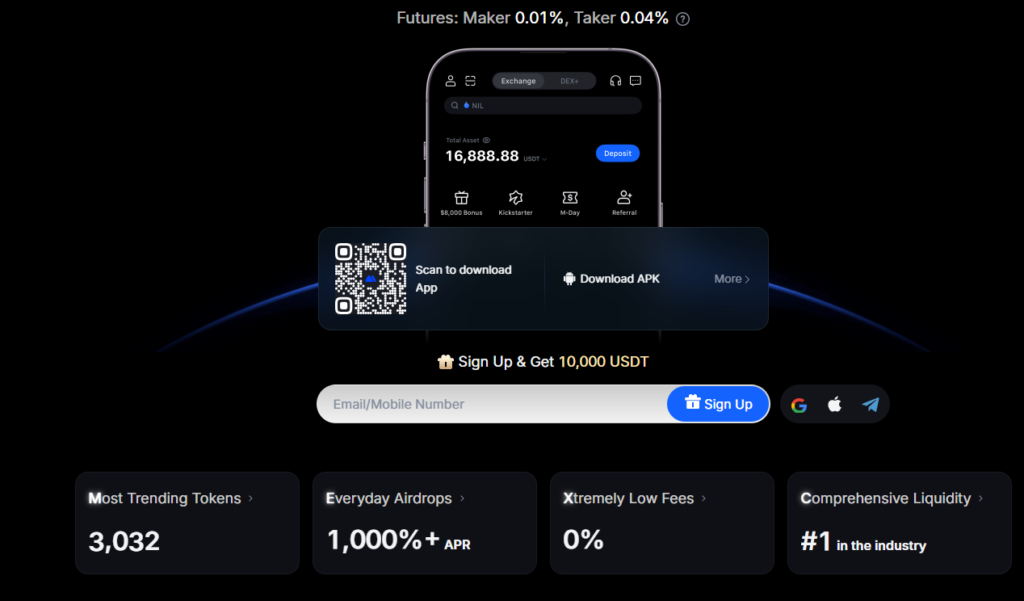
MEXC has carved out a distinctive niche in 2026 as the lowest fee major exchange on the market. The platform charges 0% maker fees on spot trades — a remarkably aggressive position that has attracted a large base of high-frequency traders and cost-conscious altcoin investors.
Taker fees stand at 0.05%, and the platform supports over 1,500 cryptocurrencies with consistently high trading volume across mid and small-cap pairs. Referral users can receive up to 70% fee rebates, and VIP tiers provide ongoing discounts for active traders.
MEXC is often one of the first exchanges to list newly launched tokens, competing directly with Gate.com for early-stage altcoin access. For a specific type of experienced trader — one who does their own research, moves quickly on new listings, and prioritizes cost efficiency above all else — MEXC is hard to beat on the metrics that matter most.
The trade-off is regulatory depth. MEXC operates with limited regulatory licensing compared to the top-tier exchanges. Experienced traders who use MEXC typically treat it as a trading venue rather than a custody solution, withdrawing to cold storage or a more regulated platform for storage.
Key Trends Shaping Crypto Exchanges in 2026
The ‘Everything Exchange’ Race
The most significant strategic trend in 2026 is the race to become a comprehensive financial platform. Coinbase, Bybit, and OKX have each made explicit moves to merge crypto trading with traditional finance — tokenized stocks, forex, commodities, and cross-border payment rails. This is no longer a fringe ambition; it’s the competitive battleground.
For investors, this means the best exchange in 2027 may look less like a crypto exchange and more like a next-generation brokerage. The platforms that execute on this vision well will have significant structural advantages in user retention and revenue diversification.
Regulation as a Competitive Moat
MiCA’s full implementation across Europe and continued regulatory development in the US, UAE, Singapore, and Australia have fundamentally changed what ‘compliance’ means for exchanges. In 2026, regulatory status is increasingly a competitive moat — not just a cost center. Exchanges like Kraken and Coinbase that built compliance infrastructure early are now benefiting from it in terms of institutional partnerships, banking access, and user trust.
DeFi and CEX Convergence
OKX’s Web3 wallet integration is the clearest example of a broader trend: centralized exchanges are building native bridges into decentralized finance. For advanced users, this means CEX-level liquidity and user experience with growing access to DeFi yield, on-chain governance, and self-custody options — all from within the same interface. This convergence is still early, but it’s accelerating.
AI-Powered Trading Tools
Multiple exchanges including Bybit (TradeGPT) and others are rolling out AI-powered trading assistants. The quality varies, and sophisticated traders should evaluate these tools critically rather than adopting them wholesale. That said, AI-driven order routing, liquidity analysis, and risk management tools are becoming a legitimate differentiator at the institutional level.
How to Choose the Right Exchange for Your Strategy
There is no single best exchange for every experienced investor. Here’s a practical decision framework:
- If you prioritize liquidity and altcoin variety above all else: Binance remains the default choice, with Gate.com or MEXC as supplements for early-stage token access.
- If regulatory certainty and institutional-grade compliance are non-negotiable: Coinbase for US investors, Kraken for global or EU-based investors.
- If derivatives are your primary instrument: Bybit or OKX offer the deepest perpetuals markets with competitive fees outside of Binance.
- If you want DeFi integration with CEX convenience: OKX’s Web3 wallet is the most mature implementation currently available.
- If fee minimization is the primary objective: MEXC’s 0% maker fee structure is hard to beat for spot trading, with Bybit leading for derivatives.
- If you’re managing significant capital with custody considerations: No exchange replaces cold storage for primary custody. Use hardware wallets for long-term holdings and keep only active trading capital on-exchange — regardless of which platform you choose.
Final Thoughts: What 2026 Is Actually Teaching Us About Exchanges
The crypto exchange space in 2026 is maturing in ways that should genuinely excite experienced investors — not just because of new features, but because the underlying infrastructure is becoming more resilient. Regulatory frameworks are stabilizing. Proof-of-reserves is becoming standard. Exchanges are competing on product quality rather than just marketing spend.
At the same time, the risks have not disappeared. Custodial risk is always present when assets sit on an exchange. Regulatory environments can shift unexpectedly. And the fundamental principle that drove crypto adoption in the first place — not your keys, not your coins — remains as relevant as ever.
The best approach for experienced investors in 2026 is to treat exchanges as tools — highly capable, increasingly feature-rich tools — rather than safe harbors. Use the right platform for the right job, manage your exposure actively, and never let convenience override sound custody practices.
The exchanges covered in this guide have earned their reputations through years of operational consistency and continued investment in their products. That’s a starting point — not a guarantee. Stay critical, stay informed, and trade well.

FAQ for Best Crypto Exchanges in 2026
Which crypto exchange has the lowest fees in 2026?
MEXC currently offers 0% maker fees on spot trades, making it the lowest-cost option for spot traders. For derivatives trading, Bybit’s 0.02% maker fee is among the most competitive globally. Binance also offers significant discounts for BNB holders and high-volume VIP traders.
Is Binance still safe to use in 2026?
Binance remains operational and is the world’s largest exchange by volume. However, its regulatory standing varies significantly by jurisdiction. Experienced investors who use Binance should maintain strict personal custody practices — keeping only active trading capital on-platform — and stay current on regulatory developments in their specific jurisdiction.
What is the most regulated crypto exchange in 2026?
Coinbase holds the most robust regulatory profile for US investors, operating as a publicly traded company with SEC oversight. Kraken holds FCA, FinCEN, and MiCA licenses across the UK, US, and EU. OKX has MiCA compliance for Europe and a VARA license in Dubai, with US expansion underway.
Can I trade stocks on crypto exchanges in 2026?
Yes — several exchanges including Coinbase, OKX, and Bybit now offer tokenized stocks that trade 24/7 on the blockchain. This is still an emerging product category, but it represents a significant structural shift in how crypto exchanges are positioning themselves relative to traditional brokerages.
What is the best exchange for altcoin trading in 2026?
For established altcoins with high volume, Binance offers the best combination of liquidity and variety. For early-stage tokens and new project listings, Gate.com and MEXC consistently list new assets before they reach larger platforms, making them preferred options for investors who want early exposure to emerging projects.
Disclaimer:
This article is for informational purposes only and does not constitute financial or investment advice. Cryptocurrency trading involves significant risk. Always conduct your own research before making investment decisions. Fee structures, regulatory statuses, and platform features are subject to change.