
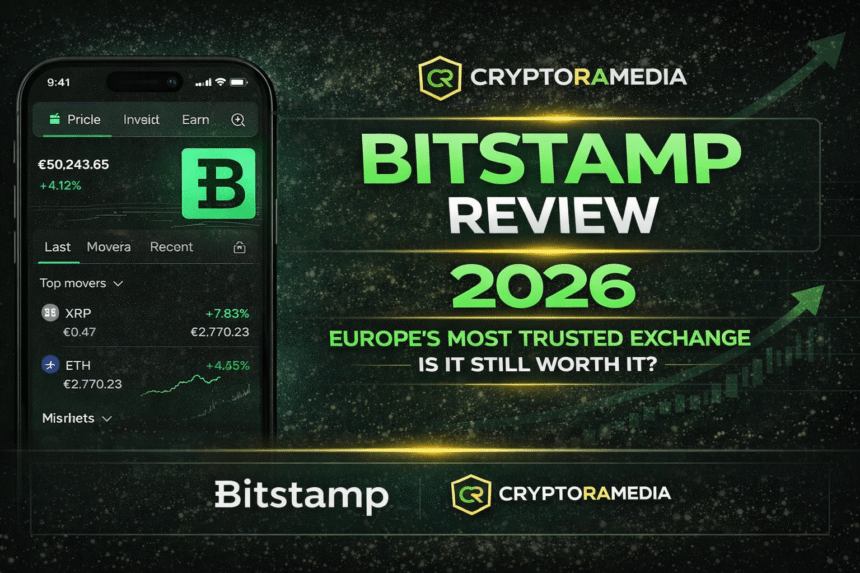
| Quick Answer: Bitstamp in 2026 is Europe’s most regulation-compliant crypto exchange 15 years operating, MiCA CASP + MiFID II licensed, 95% cold storage, Big Four annual audits since 2016, and 50+ global licences. Since June 2025 it operates as ‘Bitstamp by Robinhood’ after Robinhood’s full acquisition. It is the best exchange for EU/UK users who prioritise regulatory safety, EUR fiat access, and institutional-grade compliance above all else. The honest caveats: base fees (0.30%/0.40%) are expensive relative to Bitvavo or Bybit EU; it offers no user-verifiable Merkle-tree proof of reserves; it lists only ~115 assets; and derivatives (max 5x) are EU/EEA only. Best used as a fiat on/off-ramp and primary security vault not as an all-in-one trading platform. |
| 2011 | 50+ | 95% | 0.00% |
| Founded — one of the oldest exchanges still operating | Global licences including MiCA CASP, MiFID II, BitLicense | Client assets in offline cold storage | Maker fee at top volume tier ($1B+ 30-day volume) |
Bitstamp 2026: Quick-Facts Snapshot
| Detail | Value / Notes |
| Founded | 2011 Nejc Kodrič & Damijan Merlak, Slovenia. One of the first Bitcoin exchanges, originally built to compete with Mt.Gox |
| Parent company | Robinhood Markets Inc. acquired June 2, 2025. Now branded ‘Bitstamp by Robinhood’ across site and apps |
| Headquarters | Luxembourg (EU entity: Bitstamp Europe S.A.) + UK (Bitstamp Ltd) + offices in Slovenia, Singapore, USA |
| Users | ~5 million registered users across 100+ countries |
| Assets supported | 100–115 cryptocurrencies; ~230 spot trading pairs. Focus on liquid majors, not long-tail listings |
| Fiat currencies | USD, EUR, GBP deposits and withdrawals via SEPA, Faster Payments, ACH, bank card, Apple Pay, Google Pay, PayPal |
| Spot fees (base tier) | 0.30% maker / 0.40% taker drops to 0.00% maker / 0.03% taker at top volume tier ($1B+ 30-day volume) |
| Instant Buy fee | 4% service fee on card / Apple Pay / Google Pay / PayPal purchases. Always shown before confirmation |
| Derivatives | Perpetual futures on BTC, ETH, SOL, XRP. Max 5x leverage. Linear contracts. Available EU/EEA only (Bitstamp Financial Services) |
| Staking | ETH and ADA via Bitstamp Earn. 15% commission on ETH staking; 25% on ADA. Not available in all regions |
| Cold storage | ~95% of client assets in offline bank-grade vaults. Remaining ~5% in multisig hot wallet for operations. BitGo-backed custody |
| Security certifications | SOC 2 Type II + ISO/IEC 27001. CertiK score 86.95 (AA rating). 50+ global licenses including MiCA CASP, MiFID II MTF, BitLicense (NY) |
| Proof of reserves | No user-verifiable Merkle-tree PoR. Relies on Big Four annual audits (since 2016). 100% 1:1 backing claimed but not self-verifiable |
| 2FA options | TOTP authenticator app, SMS, email. Address whitelist, session alerts, optional IP filters for API keys |
| Mobile app | 4.8/5 App Store, 4.5/5 Google Play (Dec 2025). Basic + Pro modes. TradingView charting integration in Pro |
| Customer support | Email + ticket system. No live chat. Response times mixed faster for standard queries, slower for account/compliance issues |
| One hack on record | January 2015: ~19,000 BTC stolen from hot wallet via phishing attack. Users fully reimbursed. Zero exchange-level breaches since |
Who Is Bitstamp in 2026? The Exchange That Time (and Robinhood) Changed
| Quick Answer: Bitstamp is simultaneously one of crypto’s oldest exchanges and one of its most changed in the past 12 months. Founded in Ljubljana in 2011 as a Bitcoin-for-fiat exchange competing with the then-dominant Mt.Gox, it has survived every major crypto crisis since the Mt.Gox collapse, the 2014-2015 bear market, the 2018 crash, FTX’s implosion, and the 2022-2023 regulatory storms — without a solvency event, a customer bail-in, or a regulatory shutdown. The Robinhood acquisition completed June 2, 2025, is the most significant event in the exchange’s history since moving to Luxembourg in 2016. |
| New to This? Bitstamp was founded the year Bitcoin’s price first crossed $1. It pre-dates Coinbase by one year, Kraken by one year, and Binance by six years. This longevity is not a marketing claim it is verifiable operational history that matters when evaluating exchange risk. Every exchange that has failed (Mt.Gox 2014, QuadrigaCX 2019, Bitfinex 2016 hack, FTX 2022) has had a significantly shorter operating history than Bitstamp at the time of failure. Longevity is not a guarantee but it is the strongest single proxy for operational reliability in an industry where survival is genuinely difficult. |
The Robinhood Acquisition: What It Actually Means for Users
Robinhood Markets Inc. completed the acquisition of Bitstamp for approximately $200 million on June 2, 2025, making Bitstamp a wholly-owned subsidiary. The exchange now operates under dual branding — ‘Bitstamp by Robinhood’ across the interface — while maintaining its Luxembourg regulatory entity (Bitstamp Europe S.A.) and UK entity (Bitstamp Ltd) independently. Robinhood explicitly framed the acquisition as a global expansion vehicle, describing Bitstamp as ‘the infrastructure layer for Robinhood’s international crypto expansion.’
- Bitstamp 2026: Quick-Facts Snapshot
- Who Is Bitstamp in 2026? The Exchange That Time (and Robinhood) Changed
- The Robinhood Acquisition: What It Actually Means for Users
- MiCA CASP Licence: What It Actually Gives European Users
- Security: Bitstamp’s Strongest Argument — and Its One Honest Gap
- What 95% Cold Storage Actually Means
- The Proof of Reserves Gap: Why It Matters More Than It Used to
- Bitstamp 2026: Complete Pros and Cons
- Bitstamp Fees 2026: Competitive at High Volume, Expensive at Low Volume
- Bitstamp vs The Competition: Where It Wins and Where It Doesn’t
- Staking and Lending Fees: Honest Assessment
- Deposits and Withdrawals: Where Bitstamp Genuinely Leads
- Trading Experience: Solid for Majors, Limited for Explorers
- Asset Coverage: 115 Assets Is the Real Limitation
- Derivatives: Perpetuals at 5x — Regulated but Conservative
- Bitstamp Is Best For:
- Bitstamp Is Not Right For:
- Frequently Asked Questions
For users, three practical implications follow from Robinhood ownership. First, capital stability: Robinhood Markets is a publicly listed US company with significantly deeper balance sheet resources than the pre-acquisition independent Bitstamp. This reduces — though does not eliminate — the operational failure risk associated with being a single-entity crypto exchange. Second, product roadmap: Robinhood’s stated intention is to integrate Bitstamp’s fiat infrastructure with Robinhood’s retail-facing crypto product in Europe, potentially bringing the Robinhood app’s interface simplicity to EU crypto markets. Third, parent company risk: any significant regulatory action against Robinhood in the US could theoretically create operational constraints for Bitstamp in Europe — a new risk vector that did not exist when Bitstamp was independent.
| 🔍 Honest Take: The Robinhood acquisition is net positive for Bitstamp’s financial stability and net neutral-to-slightly-negative for the independence that made Bitstamp’s regulatory standing so clean. Robinhood’s own regulatory history includes a $65 million SEC fine in 2020 and a $70 million FINRA fine in 2021 — neither catastrophic, but both on-record. The key question for 2026 is whether Robinhood’s ownership accelerates Bitstamp’s product development or slows its independent compliance decision-making. The first year of joint operation suggests cautious optimism: no product shutdowns, one UK Earn product restoration (May 2025), and continued MiCA compliance investment. |
MiCA CASP Licence: What It Actually Gives European Users
Bitstamp is among the first exchanges to hold a full MiCA CASP (Crypto-Asset Service Provider) licence, issued by Luxembourg’s CSSF. Under MiCA’s passporting framework, this single Luxembourg licence authorises Bitstamp to operate across all 27 EU member states without requiring separate national approvals. The July 1, 2026 deadline — after which any exchange without a MiCA CASP licence must cease EU operations — creates a significant competitive moat for early licensees like Bitstamp, Kraken (Ireland), and Coinbase (Luxembourg).
The specific protections MiCA compliance provides to Bitstamp users are concrete and legally enforceable: assets must be held 1:1 in custody separate from Bitstamp’s operating capital (meaning if Bitstamp became insolvent, user assets would be ring-fenced from creditors), the exchange must maintain adequate reserve capital, client disclosures must meet EU consumer protection standards, and cybersecurity requirements are regulated at the supervisory level. For users who lived through FTX’s collapse — where customer funds were mixed with operational funds and lent to affiliated companies — these protections represent exactly the legal structure that would have prevented that outcome.
Bitstamp also holds a MiFID II Multilateral Trading Facility (MTF) licence — the same regulatory framework that governs European stock exchanges — allowing it to offer regulated derivatives products. This is the basis for Bitstamp Financial Services’ perpetual futures offering (BTC, ETH, SOL, XRP at up to 5x leverage), available to eligible EU/EEA users. No other retail crypto exchange holds both MiCA CASP and MiFID II MTF simultaneously in the EU — this dual licence status is Bitstamp’s strongest structural differentiator in the European market.
Security: Bitstamp’s Strongest Argument — and Its One Honest Gap
| Quick Answer: Bitstamp’s security posture is strong by any objective measure: 95% cold storage in bank-grade vaults, BitGo institutional custody with crime insurance, SOC 2 Type II and ISO/IEC 27001 certifications, TOTP 2FA, address whitelisting, and session monitoring. CertiK scores it 86.95 (AA rating). One major hack on record (January 2015, ~19,000 BTC via phishing) fully reimbursed, no exchange-level breach since. The honest gap: Bitstamp does not offer user-verifiable Merkle-tree proof of reserves. Users must trust the Big Four annual audits rather than verifying their own inclusion in a cryptographic reserve snapshot. |
What 95% Cold Storage Actually Means
Bitstamp stores approximately 95% of all client crypto assets in offline cold storage vaults, with the remaining ~5% in a multisig hot wallet used exclusively to service withdrawal requests and operational liquidity. The cold storage is managed through BitGo, a specialist institutional crypto custodian that also holds assets for dozens of regulated financial institutions. BitGo’s custodial arrangement includes crime insurance coverage meaning theft from the custody arrangement itself triggers an insurance claim rather than a loss to Bitstamp or its users.
The multisig hot wallet design is the primary residual security risk: the 5% of assets held online for operations is accessible to attackers in theory. This is the exact mechanism exploited in the January 2015 hack attackers social-engineered access to hot wallet files via a phishing campaign targeting individual employees. The security improvements since 2015 (hardened access controls, 2FA on all privileged systems, dedicated security team) are credible, but the hot wallet exposure category cannot be eliminated entirely on a platform that must service withdrawals in real time.
The Proof of Reserves Gap: Why It Matters More Than It Used to
Bitstamp does not offer user-verifiable Merkle-tree proof of reserves the cryptographic standard that allows each individual user to verify their balance is included in the exchange’s publicly attested reserve snapshot. Instead, Bitstamp relies on annual Big Four accounting audits, which have been conducted continuously since 2016. These audits verify that Bitstamp’s books are accurate and that liabilities are covered by assets — but they are point-in-time, conducted annually, and not individually verifiable by users.
Post-FTX, the standard for exchange trust verification shifted from ‘does it have audits?’ to ‘can users independently verify their own inclusion?’ Exchanges like Kraken and Coinbase have implemented Merkle-tree PoR systems that allow any account holder to run a verification script confirming their balance appears in the published reserve hash. Bitstamp has not done this — a gap that FXEmpire, GNcrypto, and cryptoslate.com all flag explicitly in their 2026 reviews.
| ⚠️ Watch Out: The absence of user-verifiable proof of reserves is not evidence that Bitstamp is insolvent it clearly is not, given 15 years of operation, Big Four audits, and MiCA compliance. But it means users must rely on institutional trust (auditors, regulators) rather than cryptographic self-verification. For large holdings, this is a meaningful distinction: if Bitstamp ever faced liquidity stress, you would have no independent verification mechanism ahead of any regulatory action. The practical implication: use Bitstamp for trading and fiat operations; keep significant long-term crypto holdings in self-custody or on platforms with Merkle-tree PoR (Kraken, Finst). |
Bitstamp 2026: Complete Pros and Cons
| ✅ BITSTAMP PROS | ❌ BITSTAMP CONS |
| ✅ Founded 2011 — 15 years operating without insolvency | ❌ Base fees 0.30%/0.40% — expensive vs Bitvavo, Finst, Bybit EU |
| ✅ 50+ global licences incl. MiCA CASP, MiFID II MTF, BitLicense | ❌ Instant Buy fee 4% — one of the highest in the industry |
| ✅ 95% cold storage with BitGo custody + crime insurance | ❌ No user-verifiable Merkle-tree proof of reserves |
| ✅ SOC 2 Type II + ISO/IEC 27001 certified | ❌ Only 100–115 assets — no long-tail altcoin access |
| ✅ Big Four annual audits since 2016 | ❌ No spot margin trading — borrow-to-trade not available |
| ✅ 100% 1:1 fund backing — assets never lent/staked without consent | ❌ Max 5x derivatives leverage — well below competitors |
| ✅ Best EUR fiat rails in the industry (SEPA Instant, bank wire) | ❌ Derivatives EU/EEA only — US/UK users excluded from perps |
| ✅ Beginner + Pro modes on web and mobile | ❌ USDT Earn programme ended for EU/EEA (April 2025) |
| ✅ TradingView integration in Pro interface | ❌ No live chat support — email/ticket only |
| ✅ Robinhood ownership = stronger capital backing | ❌ Mixed customer support reviews — slow for compliance issues |
| ✅ MiCA passporting: single licence covers all 27 EU member states | ❌ No launchpad, no copy trading, no trading bots |
| ✅ CertiK security score 86.95 / AA — strong third-party rating | ❌ TRC-20 / BEP-20 withdrawal routes not supported |
| ✅ Derivatives (perps) for EU users via Bitstamp Financial Services | ❌ Robinhood ownership adds parent company dependency risk |
| ✅ Lightning Network node support | ❌ KYC compulsory — no privacy-preserving trading options |
| ✅ DCA recurring buy feature built-in | ❌ Staking commission 15% ETH / 25% ADA — above market rates |
| ✅ Mobile app: 4.8/5 App Store, 4.5/5 Google Play | ❌ Limited staking asset range (ETH + ADA only) |
Bitstamp Fees 2026: Competitive at High Volume, Expensive at Low Volume
| Quick Answer: Bitstamp’s maker-taker fee model ranges from 0.30%/0.40% at the base tier to 0.00%/0.03% at the top tier ($1B+ 30-day volume). For comparison: Bitvavo charges 0.15%/0.25% at base; Bybit EU charges 0.10%/0.10% flat; Binance charges 0.01%/0.05%. Bitstamp’s base-tier fees are among the highest for a European exchange. However, its institutional fiat infrastructure justifies a premium for large EUR traders who need reliable SEPA access and compliance-grade settlement. The 4% Instant Buy fee is never worth using for regular trading. |
| 30-Day Volume (USD equiv.) | Maker Fee | Taker Fee | Practical Context |
| $0 – $1,000 | 0.30% | 0.40% | Base tier highest rate. Instant Buy at 4% is not this model; always use Pro for order-book trading |
| $1,000 – $10,000 | 0.24% | 0.34% | Still elevated vs competitors like Binance (0.01%) or Bybit (0.02%) at equivalent volumes |
| $10,000 – $100,000 | 0.20% | 0.30% | Most active retail traders fall in this range. Still higher than Coinbase Advanced at similar tiers |
| $100,000 – $500,000 | 0.14% | 0.24% | Approaching professional rates. Add SEPA withdrawal fixed cost of €3 when calculating real round-trip cost |
| $500,000 – $1M | 0.08% | 0.18% | Institutional rate range. At this volume, comparable to Kraken Pro taker fees |
| $1M – $10M | 0.05% | 0.10% | 0.10% taker now competitive with major exchanges. Maker fee very low |
| $10M – $100M | 0.03% | 0.06% | Professional market-maker range. Bitstamp historically strong on institutional EUR liquidity at this tier |
| $100M – $1B | 0.00% | 0.04% | Zero maker fee only relevant for professional desks and high-frequency institutional flow |
| $1B+ | 0.00% | 0.03% | Best available rate. Bitstamp’s institutional desk reputation makes this tier more realistic here than at newer platforms |
| 💡 Best For: For any trade above €10,000, always use Bitstamp Pro (the order book interface) rather than the Instant Buy feature. The difference: Instant Buy costs 4% in service fees. Pro order book costs 0.20-0.30% at standard volume tiers. On a €10,000 trade, the saving is €370–€380 per trade. The Instant Buy feature is only justified for first-time buyers who want frictionless entry or for small amounts where the time value of instant acquisition genuinely matters. |
Bitstamp vs The Competition: Where It Wins and Where It Doesn’t
| Exchange | Base Fees M/T | Assets | Regulation | Pairs | Max Leverage | Bitstamp Comparison |
| Bitstamp | 0.30%/0.40% | 100–115 | MiCA + MiFID II | ~230 | 5x perps | Best: fiat rails, compliance, EUR liquidity. Worst: fees at low volume, no PoR, limited altcoins |
| Kraken | 0.25%/0.40% | 200+ | MiCA + CFTC | 700+ | 50x | Better fee tiers; more assets; PoR available; stronger security track record. But no Robinhood integration |
| Bitvavo | 0.15%/0.25% | 350+ | MiCA + DNB | 350+ | None | Lower base fees; broader asset list; iDEAL/Bancontact; €755M insured custody. Best for EU casual traders |
| Coinbase | 0.40%/0.60% | 500+ | MiCA + SEC | 500+ | 5x | Higher fees; best brand trust globally; SEC dual-listed; widest altcoin access; Coinbase One subscription |
| Binance | 0.01%/0.05% | 600+ | MiCA (in process) | 1,800+ | 125x | Lowest fees; most assets; best liquidity. Weaker regulatory standing; ongoing compliance transition |
| Finst | 0.15% flat | 340+ | MiCA + AFM | 340+ | None | Full independent PoR audit; Fireblocks MPC; bankruptcy-remote structure. Best transparency in EU |
| Bybit EU | 0.10%/0.10% | 500+ | MiCA CASP | 600+ | 100x | Best EU derivatives; lowest fees; daily insurance fund. Security weaker than Kraken/Bitvavo post-2025 hack |
Staking and Lending Fees: Honest Assessment
Bitstamp Earn offers ETH staking with a 15% commission (Bitstamp keeps 15% of staking rewards) and ADA staking at 25% commission. For context: the native ETH staking yield through validators is approximately 3-4% annually, meaning Bitstamp keeps approximately 0.45-0.60% of your ETH value per year as staking commission. At 15%, Bitstamp’s ETH staking commission is higher than Coinbase (25% — worse), roughly comparable to Kraken (varies by tier), but higher than Bitvavo (lower commission on flexible staking).
The ADA 25% commission is notably high. Cardano’s native staking rewards are approximately 3-4% annually Bitstamp retains 25% of this, reducing your net yield to approximately 2.25-3%. Users with meaningful ADA positions should evaluate whether native Cardano wallet staking (via Daedalus or Yoroi, 0% commission) is more appropriate than the convenience of Bitstamp’s managed staking. The April 2025 termination of the USDT Earn Lending programme for EU/EEA customers, and the conversion of USDT balances to USDC in May 2025, reflects MiCA’s tighter restrictions on yield products for EU retail users — expect staking and yield products to evolve further as MiCA implementation matures.
Deposits and Withdrawals: Where Bitstamp Genuinely Leads
| Quick Answer: Bitstamp’s fiat rails are its strongest competitive advantage. EUR deposits via SEPA are free on Bitstamp’s side (with SEPA Instant available at eligible EU banks, transferring funds in seconds). GBP deposits and withdrawals via Faster Payments are free. USD via ACH is free. These are the cleanest, lowest-cost fiat-to-crypto rails available at any regulated European exchange the infrastructure that makes Bitstamp the default choice for institutional and professional EUR traders who need reliable, compliant fiat settlement. |
| Method | Deposit Fee | Withdrawal Fee | Key Notes |
| SEPA bank transfer | Free (Bitstamp) | €3 fixed | EUR deposits free on Bitstamp’s side. Withdrawal: €3 fixed. Processing 1–2 business days standard; SEPA Instant available in eligible EU banks = seconds |
| Faster Payments (GBP) | Free | Free | GBP deposits and withdrawals free. UK residents: best fiat rail available. Near-instant for most UK banks. Requires UK bank account |
| ACH / Wire (USD) | Free / 0.05% min | 0.10% min $25 | ACH (USA) typically free to deposit. International wire: 0.05% deposit, 0.10% withdrawal (min $25/€25/£25). Plan for 1–3 business days |
| Credit/Debit card | 4% fee | N/A | 4% instant purchase fee only justified if speed of acquisition is the primary value. Never use for regular trading. No card withdrawals |
| Apple Pay / Google Pay | 4% fee | N/A | Same 4% as card. Useful for small first purchases only. Pro traders: use SEPA or Faster Payments exclusively |
| PayPal | 4% fee | N/A | Available in select regions. Same 4% fee structure. Limited withdrawal support crypto-only withdrawal from PayPal-deposited funds |
| Crypto deposit | Free | Network fee | Crypto deposits free on Bitstamp’s side. Withdrawals incur the network fee (displayed before confirmation). BTC Lightning node available but standard customers use on-chain |
| USDC/USDT | Free | Network fee | Stablecoin deposits and withdrawals supported. Note: USDT Earn programme ended for EU/EEA in April 2025; USDT balances converted to USDC for affected users in May 2025 |
| Expert Angle: SEPA Instant transfer is the underappreciated feature that makes Bitstamp genuinely excellent for EUR traders. While a standard SEPA bank transfer takes 1-2 business days, SEPA Instant (when supported by both your bank and Bitstamp’s banking partner) completes in seconds 24/7 including weekends and holidays. For time-sensitive purchases (buying a dip, responding to a news event), the ability to move EUR onto an exchange in real time without card fees is a genuine competitive advantage. Verify that your specific bank supports SEPA Instant before relying on it; not all EU banks have implemented it. |
Trading Experience: Solid for Majors, Limited for Explorers
The Pro Interface: TradingView + Order Book for Serious Trading
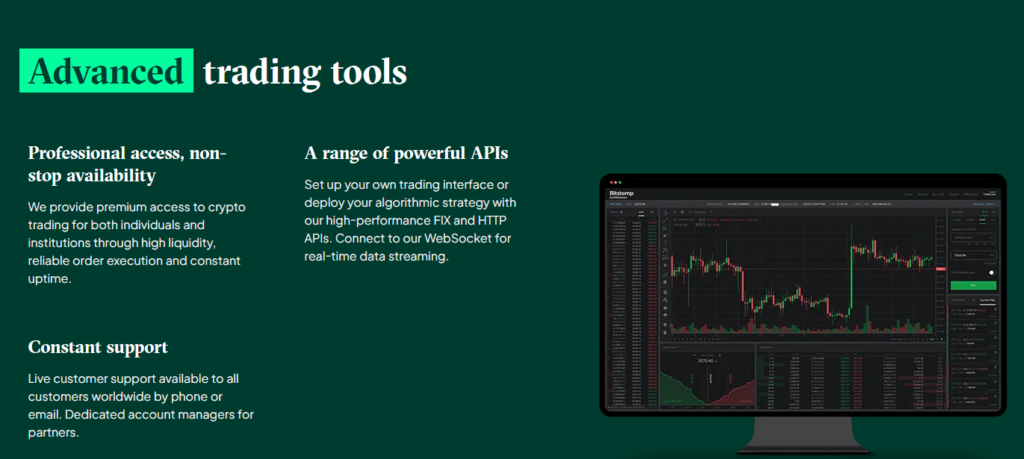
Bitstamp Pro — accessible via the web platform and the Pro mode on mobile — provides a professional trading interface with TradingView charting integration, a full order book, market depth chart, live trade feed, and support for limit, market, and stop-limit orders. The Pro interface covers approximately 230 spot trading pairs on 100-115 assets, with the deepest liquidity on major USD, EUR, and GBP pairs: BTC/USD, BTC/EUR, ETH/USD, ETH/EUR, XRP/USD, SOL/USD, and their GBP equivalents.
The trading interface is clean and stable — GNcrypto’s 2026 test explicitly noted the Pro terminal ‘stayed stable and uncluttered’ through volatility events. For traders whose primary activity is BTC, ETH, SOL, XRP, and the major stablecoins in EUR or USD, Bitstamp’s order book depth and execution quality is comparable to Coinbase Advanced and Kraken Pro. The liquidity on EUR pairs specifically — a product of Bitstamp’s institutional EUR client base — provides tighter spreads than most competitors on the EUR side of the book.
Asset Coverage: 115 Assets Is the Real Limitation
Bitstamp lists approximately 100-115 cryptocurrencies with roughly 230 trading pairs. This is intentional — Bitstamp’s listing criteria explicitly prioritise foundational values, technology quality, legal compliance, and market value over speed of listing new assets. The exchange missed the 2024 meme coin season entirely. It will not list speculative new tokens, governance tokens from unaudited protocols, or assets without clear legal classification.
For the significant portion of crypto investors who trade beyond the top 20-30 assets by market cap, Bitstamp’s asset coverage is a genuine limitation. Binance lists 600+, Coinbase lists 500+, Bitvavo lists 350+, Kraken lists 200+. If your strategy involves altcoin rotation, Solana ecosystem tokens, emerging DeFi protocols, or any asset outside the well-established majors, Bitstamp cannot serve those needs. This is not a flaw in Bitstamp’s strategy — it is a deliberate positioning decision with clear trade-offs.
Derivatives: Perpetuals at 5x — Regulated but Conservative
Bitstamp Financial Services, a separate licensed entity, offers perpetual futures contracts on BTC, ETH, SOL, and XRP for eligible EU/EEA users. Maximum leverage is 5x. All contracts are linear (USDT-settled). Maker fees are -0.005% (a rebate), taker fees are 0.015%, and liquidation fees are 0.05%. These are among the most regulation-compliant derivatives available in the EU — operated under the MiFID II MTF licence rather than the lighter MiCA CASP framework.
The 5x maximum leverage is, however, conservative by any competitive comparison. Bybit EU offers 100x on perpetuals. Binance offers 125x. Kraken offers 50x. Even for traders who have no interest in extreme leverage, the 5x limit restricts hedging strategies that professional traders routinely use at 10-20x for delta-neutral positions. US users, UK users, and users outside the EU/EEA cannot access Bitstamp’s derivatives at all under the current licensing structure.
The clearest conclusion from the competitor comparison: Bitstamp wins on regulatory depth (MiCA + MiFID II + 50+ licences), institutional fiat infrastructure (SEPA Instant EUR rails), and longevity (15 years). It loses on fees at low-to-medium volume, asset breadth, proof of reserves quality, and derivatives depth. The right question is not ‘is Bitstamp better than Kraken?’ but ‘what specific role should Bitstamp play in my exchange strategy?’
| 💡 Best For: The two-exchange strategy that works best for European investors in 2026: Bitstamp for EUR fiat entry/exit and holding regulated positions in BTC, ETH, SOL, XRP — using its industry-leading SEPA rails and MiCA compliance as the safety anchor. A second exchange (Bitvavo for low-cost trading, Bybit EU for derivatives, Finst for maximum transparency) for active trading and altcoin access. Use Bitstamp as the bank-rail interface; use a specialist platform for everything else. |
Who Should Use Bitstamp in 2026?
Bitstamp Is Best For:
EU and EEA users who want MiCA certainty: The July 2026 MiCA deadline will force any unlicensed exchange to stop serving EU users. Bitstamp is already fully compliant — users face zero access disruption risk from the regulatory transition that will affect thousands of smaller platforms.
EUR-denominated long-term investors: If your primary activity is buying BTC, ETH, SOL, or XRP in EUR and holding for 6-24+ months, Bitstamp’s SEPA fiat rails, institutional cold storage, and compliance posture make it the safest regulated choice in Europe. The higher base fee is amortised over a long holding period and is irrelevant on a 10%+ annual return.
Institutional and professional traders: Bitstamp’s institutional desk, EUR liquidity depth, MiFID II MTF licence, and Big Four audit trail make it the exchange that compliance teams at asset managers, family offices, and corporate treasuries are most comfortable onboarding. The 29% of workforce dedicated to compliance, legal, risk, and security is not found at competitors of comparable size.
UK investors: FCA-registered, Faster Payments support, GBP pairs, and Earn staking reopened for UK users in May 2025. For UK users, Bitstamp offers the best combination of regulatory standing and GBP banking rails among European exchanges.
Beginners who want a trustworthy first exchange: The Basic mode, mobile app (4.8/5 App Store), built-in DCA recurring buy feature, and clean fiat-to-crypto onboarding make Bitstamp one of the most accessible regulated exchanges for first-time buyers. The higher base fee is a real cost, but the peace of mind from MiCA compliance is genuine value for users who don’t yet know how to evaluate exchange risk themselves.
Bitstamp Is Not Right For:
Altcoin traders: 100-115 assets misses the vast majority of the market. If your strategy extends beyond major-cap assets, you need Bitvavo, Coinbase, Kraken, or Binance for coverage.
Fee-sensitive active traders: 0.30%/0.40% base fees are materially higher than Bitvavo (0.15%/0.25%), Bybit EU (0.10%/0.10%), and Finst (0.15% flat). Regular traders who execute multiple times per week will pay significantly more on Bitstamp at equivalent volumes. Switch to Bitvavo or Bybit EU for active trading.
Derivatives traders: 5x maximum leverage is insufficient for most professional hedging and position strategies. Bybit EU (100x), Kraken Pro (50x), and Binance (125x) serve this need better.
Users who need cryptographic PoR verification: If self-verifiable proof of reserves is a prerequisite — as it should be for large holdings — Kraken and Finst offer Merkle-tree verification that Bitstamp does not.
Frequently Asked Questions
Is Bitstamp safe in 2026?
Bitstamp is one of the safest centralised exchanges available to European and US users in 2026 by regulatory and operational standards. It holds 50+ global licences including a MiCA CASP licence, MiFID II MTF licence, and NYDFS BitLicense. It stores approximately 95% of client assets in offline cold storage managed by BitGo with crime insurance. It has been audited annually by a Big Four accounting firm since 2016. SOC 2 Type II and ISO/IEC 27001 certifications are current. It has operated without insolvency or uncompensated client losses for 15 years. The one honest caveat: it does not offer user-verifiable Merkle-tree proof of reserves — users must rely on institutional audits rather than cryptographic self-verification. For large holdings ($10,000+), this is a meaningful gap best addressed by keeping long-term holdings in self-custody or on a platform with user-verifiable PoR.
What happened with Bitstamp and Robinhood?
Robinhood Markets Inc. completed the acquisition of Bitstamp for approximately $200 million on June 2, 2025. Bitstamp now operates as a wholly-owned Robinhood subsidiary under the dual brand ‘Bitstamp by Robinhood.’ The exchange maintains its separate regulatory entities in Luxembourg (Bitstamp Europe S.A., MiCA CASP licensed) and the UK (Bitstamp Ltd, FCA registered). Operationally, most users experienced minimal change in the first year: the platform interface adopted Robinhood branding, the UK Earn staking product was restored in May 2025, and the USDT Earn programme for EU/EEA users was ended in compliance with MiCA requirements. The acquisition is broadly seen as strengthening Bitstamp’s financial stability while introducing parent-company dependency risk that did not previously exist.
What are Bitstamp’s fees in 2026?
Bitstamp uses a volume-tiered maker-taker fee model for spot trading. Base tier (under $1,000 30-day volume): 0.30% maker / 0.40% taker. The top tier ($1B+ 30-day volume): 0.00% maker / 0.03% taker. Derivatives perpetuals (EU/EEA only): -0.005% maker (rebate) / 0.015% taker / 0.05% liquidation fee. The Instant Buy feature (card, Apple Pay, Google Pay, PayPal) carries a 4% service fee — always use Pro order book trading instead. SEPA EUR deposits are free on Bitstamp’s side; EUR SEPA withdrawals cost a fixed €3. Crypto deposits are free; crypto withdrawals incur the network fee shown at confirmation. For comparison: Bitvavo charges 0.15%/0.25% at base, Bybit EU charges 0.10%/0.10% flat. Bitstamp’s fees are competitive at high volume but expensive at low volume.
How does Bitstamp compare to Kraken and Coinbase for European users?
All three hold MiCA licences and serve EU users with strong regulatory standing. Bitstamp’s advantages over both: best EUR fiat rails (SEPA Instant), dual MiCA + MiFID II licensing (the only exchange with both), and deepest institutional EUR liquidity. Bitstamp’s disadvantages versus Kraken: Kraken offers user-verifiable Merkle-tree proof of reserves, a longer list of assets (200+), lower base fees (0.25%/0.40%), and higher derivatives leverage (50x vs 5x). Bitstamp’s disadvantages versus Coinbase: Coinbase lists 500+ assets, has SEC dual-regulation as a public company, and offers a zero-fee subscription (Coinbase One) for high-volume users. The practical conclusion: Bitstamp is the best choice specifically for EUR-denominated fiat operations and institutional compliance; Kraken is better for most active retail traders; Coinbase is better for the widest asset access.
Does Bitstamp have proof of reserves?
Bitstamp does not currently offer user-verifiable Merkle-tree proof of reserves — the cryptographic standard that allows each user to independently verify their balance is included in the exchange’s attested reserve snapshot. Bitstamp instead relies on annual Big Four accounting audits (conducted continuously since 2016) and claims 100% 1:1 backing of all client assets. The distinction matters post-FTX: Big Four audits verify financial accuracy but are conducted annually, are not individually verifiable by users, and are point-in-time snapshots. Merkle-tree PoR (offered by Kraken, Coinbase, Finst, and others) provides real-time or near-real-time cryptographic verification. Bitstamp’s regulatory disclosures under MiCA provide additional assurance, but third-party reviewers including FXEmpire, cryptoslate.com, and thecoinomist.com all flag the absence of user-level PoR verification as a meaningful gap relative to best practice.
Is Bitstamp available in the US?
Yes. Bitstamp holds a NYDFS BitLicense (obtained April 2019) and operates in the United States, serving US users through Bitstamp USA Inc. US users can access spot trading on major crypto pairs. However, US users cannot access Bitstamp’s derivatives (perpetual futures) products — these are available to EU/EEA users only under the MiFID II licence. US users also cannot access certain Earn (staking and lending) products that are EU/EEA-specific. For US traders seeking regulated crypto derivatives, Kraken Pro (50x, CFTC-compliant) remains the primary available option.
What is the best alternative to Bitstamp for European traders?
It depends on your specific priority. For lower fees with comparable European regulatory standing: Bitvavo (0.15%/0.25%, MiCA + DNB, 350+ assets, best local payment methods for Netherlands/Belgium/Germany). For maximum transparency and proof of reserves: Finst (full independent PoR audit, Fireblocks MPC custody, bankruptcy-remote structure, 0.15% flat fee). For derivatives trading with MiCA compliance: Bybit EU (0.10%/0.10% fees, 100x leverage, MiCA CASP). For the widest asset selection in the EU: Binance (600+ assets, 0.01%/0.05% fees, MiCA compliance in process) or Coinbase (500+ assets, MiCA licensed). For traders who need primarily EUR fiat access and major-asset trading with maximum regulatory assurance, Bitstamp remains the best single option — but most European investors benefit from a two-exchange approach with Bitstamp handling fiat and a specialist handling trading.