
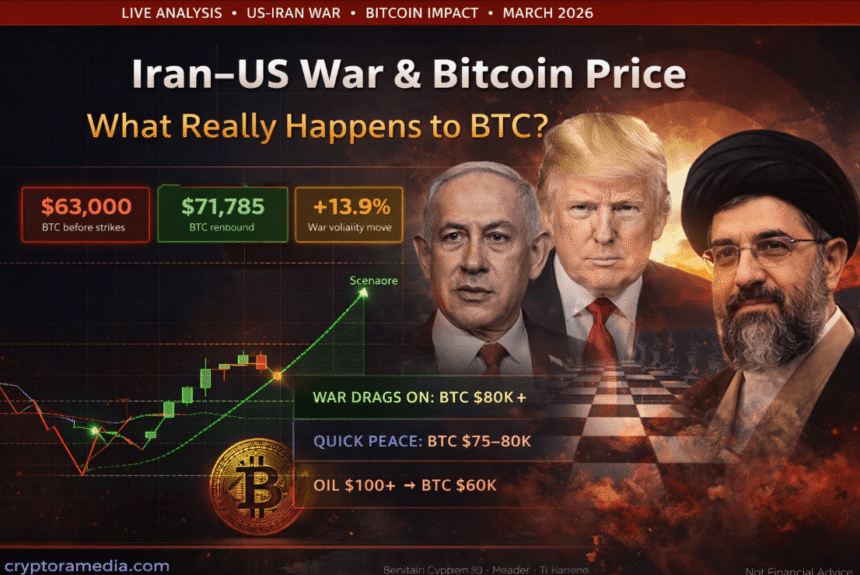
| Direct Answer: Iran War and Bitcoin Price in 2026 On February 28, 2026, the US-Israeli joint strike on Iran caused Bitcoin to drop 15% to $63,000 within hours. By March 10, 2026, Bitcoin had recovered to $71,785 — up 13.9% from the war low — after Trump signalled an end to the conflict. Expert consensus: Bitcoin wins either way — from Fed money printing if war drags on, or from relief buying if peace comes. |
Iran war Bitcoin — two words that have defined every crypto trader’s morning for two weeks. On February 28, 2026, the US-Israeli joint operation “Operation Midnight Hammer” hit Iranian targets. $300 million in crypto liquidations followed within hours. Bitcoin crashed to $63,000.
- What the Iran War Did to Bitcoin: Day by Day
- Why Bitcoin Crashed — And Why It Recovered
- The Iran War’s Biggest Risk for Bitcoin: Oil
- What the Experts Say: Iran War & Bitcoin Price in 2026
- Iran War Bitcoin Scenarios for 2026: Bull, Base & Bear
- What This Means for European Crypto Holders
- Frequently Asked Questions
Then something interesting happened. It bounced back. Fast. By March 10, BTC had climbed to $71,785. According to Bloomberg, the recovery began the moment Trump told CBS News that the operation was “ahead of schedule.” This is the story of what war actually does to Bitcoin — and what comes next.
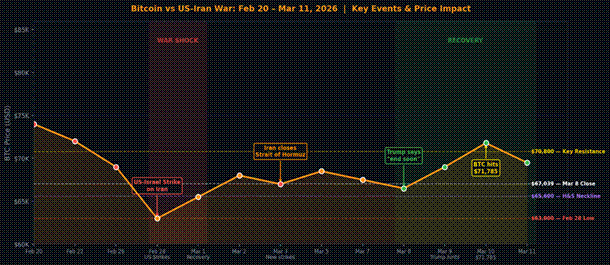
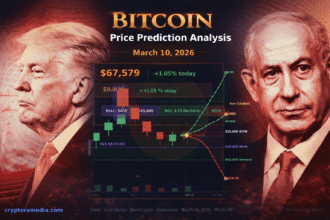
Bitcoin price timeline during Iran-US war February 28 to March 11 2026 — crash to $63K then rally to $71,785 | Cryptora Media
What the Iran War Did to Bitcoin: Day by Day
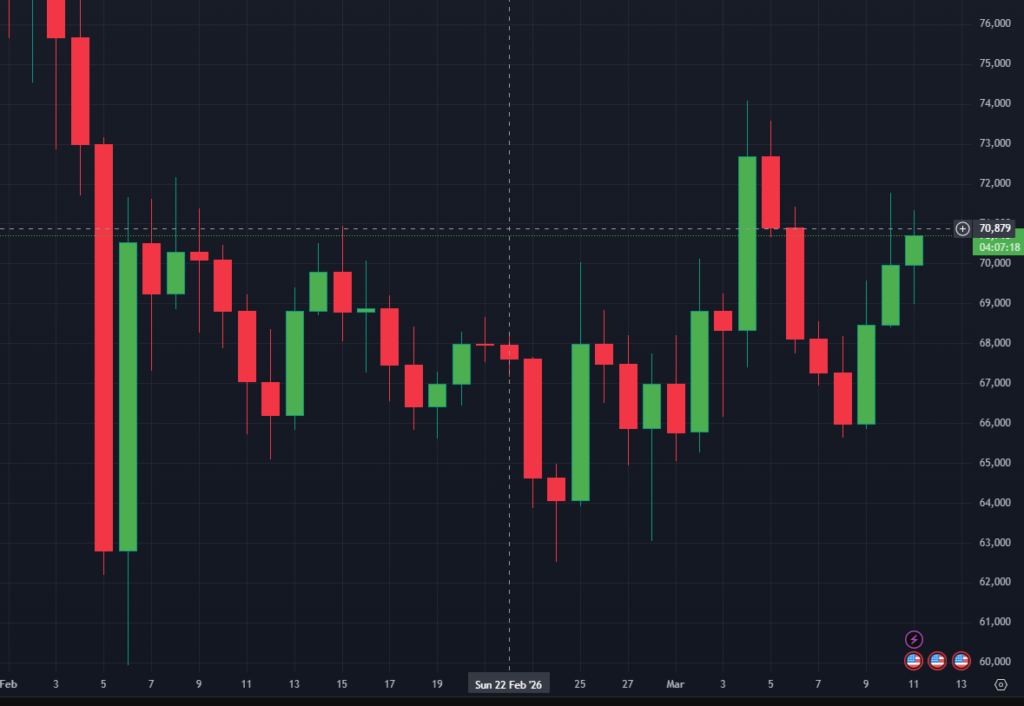
| Date | Event | BTC Price | Impact |
| Feb 28, 2026 | US-Israel launch “Operation Midnight Hammer” | $63,000 (-15%) | Biggest single-day drop since FTX collapse. $300M liquidated. |
| Mar 1 | Markets reopen. Short-covering begins. | $68,000 (+8%) | BTC recovers on thin volume. Iran fires back. |
| Mar 3 | Israel launches fresh strikes. Iran drones hit US Embassy, Riyadh. | $66,000–$68,800 | BTC range-bound. Extreme Fear index at 15. |
| Mar 5 | Iran de facto closes Strait of Hormuz. Oil spikes to $85/barrel. | $67,000 | Oil rising = re-inflation fear = rate cuts delayed. |
| Mar 9 | Trump tells CBS: war “ahead of schedule” | $69,523 (+3.4%) | Risk-on signal. BTC, ETH, SOL all pump. |
| Mar 10 | Trump hints at joint Netanyahu decision on peace. | $71,785 (+4%) | Strongest day since ATH. Volume surges 53%. |
| Mar 11 | BTC pulls back from $71,750 resistance. | $69,500 | War still ongoing. Resistance holds. Cautious session. |
Why Bitcoin Crashed — And Why It Recovered
The Crash: Three Reasons
- Institutional risk-off: When missiles flew, ETF holders sold. February 2026 saw $3.8 billion in net Bitcoin ETF outflows — the worst month since ETFs launched in January 2024.
- Oil shock mechanism: Brent crude surged to $85/barrel after Iran partially closed the Strait of Hormuz — which carries 20% of global oil. Oil up = inflation fears up = Fed rate cuts off the table.
- Dollar strength: The DXY dollar index hit a multi-month high. A strong dollar historically pressures Bitcoin. Institutional money rotated into gold, which gained $16 billion in ETF inflows over the same period.
The Recovery: Three Reasons
- Bitcoin is the only 24/7 market. It absorbed the panic in real time while equities were closed. By Monday, short-sellers were forced to cover.
- Whale accumulation: On-chain data from Glassnode shows large wallet holders (1,000–1,000,000 BTC) showed virtually no balance changes during the crash — meaning institutional holders did not sell.
- Peace catalyst: The moment Trump signalled a resolution, $FOMO returned. According to Apollo Crypto research head Pratik Kala, the $68,000 zone proved to be extremely strong support throughout the war.
| “The tape has been very strong for Bitcoin since the war started, with the $68,000 region being a very strong support. To the upside, we’re eyeing a push above $73,000 toward $87,000 as the next major resistance.” — Pratik Kala, Head of Research, Apollo Crypto |
The Iran War’s Biggest Risk for Bitcoin: Oil
The single most important variable is not missiles — it’s oil. Jake Ostrovskis, head of OTC at Wintermute, stated it plainly:
| “The oil move matters more for crypto than the geopolitics itself. If Brent stays above $80 for more than a few sessions, the re-inflation narrative hardens and the March rate cut that was already a long shot becomes impossible.” — Jake Ostrovskis, Head of OTC, Wintermute |
| Brent Crude Price | Inflation Risk | Fed Rate Cuts | Bitcoin Outlook |
| Below $75/barrel | Low | Likely mid-2026 | BULLISH — rate cut narrative returns. BTC targets $80K+ |
| $75–$85/barrel | Moderate | Uncertain — Q3/Q4 | NEUTRAL — BTC holds $65K–$75K range |
| $85–$100/barrel | High | Delayed to 2027 | BEARISH near-term — BTC risk of $55K–$60K retest |
| Above $100/barrel | Extreme — 2022 scenario | Off the table | VERY BEARISH near-term — BTC could test $50K–$55K |
Current level: Brent crude is at $85/barrel as of March 11, 2026 — sitting right at the danger zone. Watch this number more than anything else.
What the Experts Say: Iran War & Bitcoin Price in 2026
| Expert | View | Target | Confidence |
| Arthur Hayes (Maelstrom) | War forces Fed to print money + cut rates. Every US Middle East conflict ended with monetary easing. Bitcoin wins long-term. | $250K (2026) | High conviction — but timing risk |
| Mark Connors (3iQ) | Prolonged war = deficit spending = dollar debasement = BTC up. US debt growing at 14% annualised rate since mid-2025. | $80K+ near-term | Medium conviction |
| London Crypto Club | Either way Bitcoin wins. Quick peace = buying bonanza. Long war = hedge + Fed liquidity = BTC up. | $75K–$80K (Q2 2026) | High conviction |
| QCP Capital | Historical parallel: June 2025 Iran strike — BTC fell below $100K then rallied to $123K within weeks. | $74K–$75K calls active | Medium — watching ETF flows |
| Wintermute (Ostrovskis) | Oil is the real driver. Sub-$80 oil = bullish. $80+ sustained = rate cuts off = bearish near-term. | Data-dependent | Cautious |
Iran War Bitcoin Scenarios for 2026: Bull, Base & Bear
| Scenario 1: Quick Resolution 2 to 4 Weeks (30% probability) Trigger: Peace deal or regime change. Oil falls back to $65–$70/barrel. BTC Target: $75,000–$80,000 (mirrors June 2025 pattern where BTC went from sub-$100K to $123K) What to watch: ETF flows turning positive for 3+ consecutive days = confirmation signal. Historical precedent: After the June 2025 Iran strike, BTC fell below $100K and rallied to $123K within weeks (QCP Capital). |
| Scenario 2: Prolonged Conflict 2 to 6 Months (45% probability) Trigger: War drags on. Strait of Hormuz partially closed. Oil holds $80–$100. BTC Target near-term: $62,300–$67,000 range (accumulation zone). Long-term: $85,000–$100,000 as Fed eventually eases. The macro logic: Deficit spending expands → US debt grows → Fed forced to cut rates → liquidity flood → Bitcoin up. Arthur Hayes thesis: “The longer Trump engages in the costly activity of Iranian nation-building, the higher the likelihood the Fed lowers interest rates.” |
| Scenario 3: Oil Shock Above $100 (25% probability) Trigger: Strait of Hormuz fully closed. Oil spikes above $100/barrel. BTC Target: $55,000–$60,000 retest. H&S pattern at $65,600 breaks. Bear case active. The 2022 parallel: Ukraine invasion sent oil above $120/barrel. Inflation surged. Fed hiked aggressively. BTC fell 75%. Risk signal to watch: Brent crude crossing $100 with no diplomatic signals. If this happens — reduce exposure. Scenario 3: Oil Shock Above $100 (25% probability) Trigger: Strait of Hormuz fully closed. Oil spikes above $100/barrel. BTC Target: $55,000–$60,000 retest. H&S pattern at $65,600 breaks. Bear case active. The 2022 parallel: Ukraine invasion sent oil above $120/barrel. Inflation surged. Fed hiked aggressively. BTC fell 75%. Risk signal to watch: Brent crude crossing $100 with no diplomatic signals. If this happens — reduce exposure. |
What This Means for European Crypto Holders
If you hold Bitcoin in Europe in March 2026, here is the practical framework:
| If you are… | The smart move is… |
| A long-term holder (1–3 year timeframe) | Hold. The Arthur Hayes / London Crypto Club thesis is intact. Every US war ends with monetary easing. BTC benefits. Zoom out. |
| A trader (weeks to months) | Wait for $65,600–$66,000 (H&S neckline retest) for best long entry. Stop below $64,800. Target $70,800 first. |
| New to crypto / nervous about the war | Do not make panic decisions. Bitcoin dropped 15% on Feb 28 and recovered 13.9% within 10 days. Volatility is the feature, not the bug. |
| Worried about more downside | Set a clear exit rule: if BTC closes a daily candle below $62,300 demand zone on high volume — then reassess position size. |
Bottom line: The iran war bitcoin price connection is real — but the direction depends on one variable. Watch Brent crude. Below $80 = bullish. Above $100 = risk-off. Everything else is noise.
Not financial advice. All data sourced from Bloomberg, CoinDesk, BeInCrypto, Fortune, DL News, Glassnode and QCP Capital as of March 11, 2026, 09:00 UTC.
More Read




Frequently Asked Questions
What happened to Bitcoin when the US attacked Iran?
When the US and Israel launched joint strikes on Iran on February 28, 2026, Bitcoin dropped approximately 15% to $63,000 within hours — the sharpest single-day decline since the FTX collapse in 2022. Over $300 million in crypto liquidations occurred during the strike weekend. However, Bitcoin recovered rapidly: by March 1, it had rebounded to $68,000, and by March 10 it reached $71,785 — demonstrating that the initial crash was driven by panic selling and forced liquidations rather than a structural change in Bitcoin’s fundamentals.
Is the Iran war good or bad for Bitcoin?
When the US and Israel launched joint strikes on Iran on February 28, 2026, Bitcoin dropped approximately 15% to $63,000 within hours — the sharpest single-day decline since the FTX collapse in 2022. Over $300 million in crypto liquidations occurred during the strike weekend. However, Bitcoin recovered rapidly: by March 1, it had rebounded to $68,000, and by March 10 it reached $71,785 — demonstrating that the initial crash was driven by panic selling and forced liquidations rather than a structural change in Bitcoin’s fundamentals.
What is the Bitcoin price prediction during the Iran-US war in 2026?
The Bitcoin price prediction during the Iran-US war 2026 has three scenarios: Bull case (30% probability) — a quick resolution sends BTC to $75,000–$80,000, mirroring the June 2025 pattern. Base case (45%) — prolonged conflict keeps BTC in the $65,000–$73,000 range before eventually breaking higher as Fed easing expectations build. Bear case (25%) — oil above $100/barrel delays rate cuts, sends BTC to $55,000–$60,000. Bitcoin is trading at $69,500 as of March 11, 2026, after recovering from a war low of $63,000.
What does Arthur Hayes say about Iran war and Bitcoin?
Arthur Hayes, co-founder of BitMEX and CIO of Maelstrom, published an essay on March 2, 2026 arguing that a prolonged US-Iran conflict would force the Federal Reserve to print money and cut interest rates — ultimately sending Bitcoin higher. Hayes cited a four-decade historical pattern: every major US military campaign in the Middle East since 1985 has been followed by Fed monetary easing. He maintains a Bitcoin price target of $250,000 in 2026, with longer-term targets of $500,000–$750,000 by 2027 under sustained monetary expansion.
Why did Bitcoin recover after the Iran strike?
Bitcoin recovered after the February 28, 2026 Iran strike for three reasons: First, it is the only major asset that trades 24/7, meaning it absorbed panic selling in real time and forced short-sellers to cover by Monday morning. Second, on-chain Glassnode data shows large wallet holders (whales) did not sell during the crash — structural demand held. Third, Trump’s comments on March 9 suggesting the conflict was “ahead of schedule” triggered a risk-on sentiment shift, sending BTC to $71,785 on March 10 — up 13.9% from the war low in just 10 days.
What is the Iran-Bitcoin oil connection?
The oil price is the most important variable connecting the Iran-US war to Bitcoin’s price. According to Jake Ostrovskis, head of OTC at Wintermute, if Brent crude oil stays above $80 per barrel, the re-inflation narrative hardens and Federal Reserve rate cuts become unlikely. Higher oil prices → higher inflation → Fed stays hawkish → risk assets including Bitcoin face headwinds. Iran’s de facto closure of the Strait of Hormuz — which carries 20% of global oil — sent Brent to $85/barrel by March 11, 2026. If oil breaks above $100, Bitcoin faces a potential test of $55,000–$60,000.
What is the historical precedent for Bitcoin during Middle East conflicts?
The most relevant historical precedent is the June 2025 US strike on Iranian nuclear facilities, during which Bitcoin fell below $100,000 before rallying to $123,000 within weeks, according to QCP Capital. This mirrors the current pattern of a sharp crash followed by rapid recovery. A longer parallel is the 2022 Russia-Ukraine war: oil surged above $120/barrel, the Fed was forced into aggressive rate hikes, and Bitcoin fell 75% over 12 months. The key difference between a bullish and bearish outcome in 2026 is whether oil remains manageable (below $85) or enters a sustained shock above $100 per barrel.