
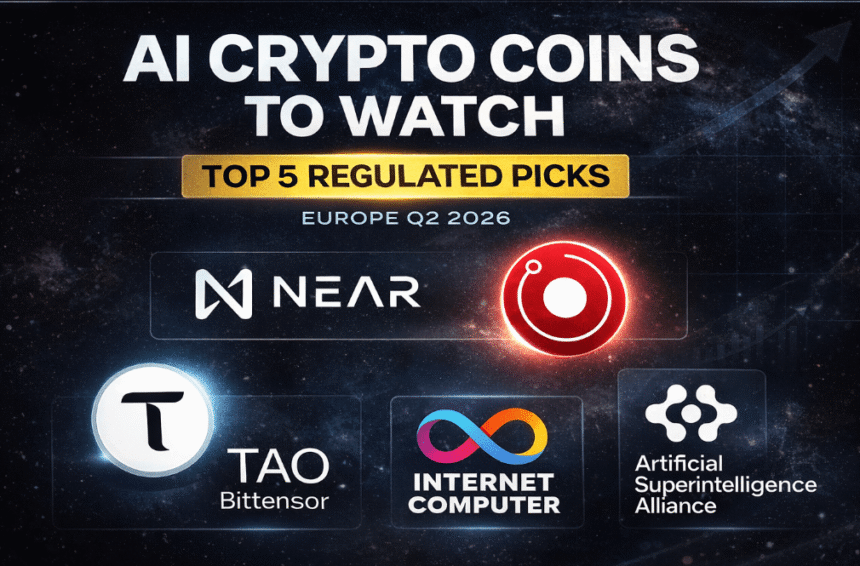
| Quick Answer: The AI crypto coins sector has a total market cap exceeding $26 billion as of early 2026, with Bittensor (TAO), ASI Alliance (FET), Render (RNDR), NEAR Protocol (NEAR), and Internet Computer (ICP) as the five most credible projects by market cap, real utility, and liquidity available on MiCA-licensed European exchanges. TAO is the category leader — a genuine decentralised machine-learning network, not a rebranded DeFi token. FET/ASI brings together three AI projects (Fetch.ai, SingularityNET, Ocean Protocol) into a unified ecosystem. RNDR provides real GPU marketplace infrastructure. NEAR is building the best blockchain substrate for AI agents. ICP offers the most ambitious — and most technically complex — on-chain AI hosting vision. All five carry high risk and extreme volatility. None of this is investment advice. This article provides a rigorous utility and risk analysis to help European investors understand what they are buying — not buy signals. |
| ⚠️ Risk Alert: All AI crypto tokens are high-risk, speculative investments. The AI crypto market cap of $26B represents investor expectations about future AI adoption on blockchain — expectations that may not materialise on the anticipated timeline or at all. The sector faces existential competition from centralised AI giants (OpenAI, Google, Microsoft) that have vastly superior resources. Token prices are driven partly by real utility adoption and partly by narrative momentum — the latter can reverse sharply. Never invest more than you can afford to lose entirely. Always use MiCA-licensed European exchanges (see Section 7). This article is for educational purposes only and is not financial advice. |
| >$26B | 120+ | 200+ | Jul 2026 |
| Total AI crypto market cap, Jan 2026 (CoinGecko snapshot) | Active subnets on Bittensor — specialised AI tasks, growing | AI crypto projects on CoinMarketCap — selection quality matters | MiCA deadline — use only licensed exchanges for all purchases |
Why AI Crypto? The Investment Thesis in Plain Language
| Quick Answer: The convergence of artificial intelligence and blockchain creates a specific investment opportunity: infrastructure tokens that power decentralised versions of the compute, data, and intelligence services that centralised companies currently monopolise. If AI continues its trajectory of becoming the dominant computing paradigm, the question is whether that AI runs on centralised infrastructure (OpenAI/Microsoft, Google/Deepmind, Amazon/AWS) or on decentralised networks where access is permissionless, costs are market-driven, and ownership is distributed via tokens. The AI crypto thesis is a bet on the latter — that decentralised alternatives will capture a meaningful share of the AI compute, data, and agent markets. This is a high-conviction, long-horizon thesis with genuine uncertainty. |
| New to This? There is an important distinction between genuine AI infrastructure tokens and rebranded projects that added ‘AI’ to their marketing in 2023-2024. Genuine AI utility means: the token is required to use the network’s actual AI services (compute, data, model training). Bittensor (TAO) requires TAO to access decentralised ML model competition. Render (RNDR) requires RNDR to rent GPU compute. These are real utility tokens. Contrast with projects that claim ‘AI’ features but whose token has no functional connection to AI service usage — those are narrative tokens, not utility tokens. The five projects in this guide were selected specifically because their token utility is functionally connected to actual AI services. |
The European regulatory context adds a specific filter for EU investors. MiCA’s July 2026 deadline means all AI tokens purchased should be on MiCA-licensed exchanges — not because token quality is affected, but because exchange access and asset custody security are affected. Several smaller exchanges that list obscure AI tokens may lose EU operating licences after July 2026. Sticking to the five tokens listed here — all available on multiple MiCA-licensed platforms — avoids that risk.
- #1 Bittensor (TAO) The Decentralised Machine-Learning Network — Bitcoin for AI Model Competition
- What Bittensor Actually Does
- Why TAO Is the Category Leader
- The Honest Risks
- #2 Artificial Superintelligence Alliance (FET) The Three-Project AI Ecosystem Merger — Agents + Data + Models Under One Token
- What the ASI Alliance Actually Is
- The Genuine Innovation: Autonomous AI Agents
- The Honest Risks
- #3 Render Network (RNDR) Decentralised GPU Marketplace — Idle Compute Power for AI Training and 3D Rendering
- What Render Actually Does
- AI-Specific Use Case: Decentralised Inference
- The Honest Risks
- #4 NEAR Protocol (NEAR) The L1 Blockchain Built for AI Agents — Sub-Second Finality, Consumer-Grade UX
- What NEAR Protocol Actually Does
- NEAR’s AI Agent Positioning
- The Honest Risks
- #5 Internet Computer (ICP) On-Chain Everything — Full Web Applications and AI Models Running Entirely On-Chain
- What ICP Actually Does (It’s Genuinely Different)
- The Honest Risks
- Position Sizing for High-Risk Speculative Assets
- DCA Over Entry Points, Not Lump Sum
- The 2026 EU Tax Consideration
- FAQ
The Five Picks: Quick Comparison Table
| Token | Project | Market Cap (approx.) | Key Facts Q1 2026 | Risk Level | Available On (MiCA-licensed EU) |
| #1 TAO | Bittensor | ~$1.8B | Decentralised ML network · 120+ active subnets · TAO halving completed · Grayscale ETF S-1 filed · ~35% circulating supply (dilution risk) | High | Coinbase · Kraken · Bitstamp · Bitpanda · OKX |
| #2 FET | ASI Alliance (Fetch.ai + SingularityNET + Ocean) | ~$2–3B combined | Merged ASI token ecosystem · AI agents + data marketplace + model services · FET is primary gateway token | High | Coinbase · Kraken · Bitpanda · Binance · OKX |
| #3 RNDR | Render Network | ~$750M–1B | Decentralised GPU marketplace · AI inference + 3D rendering · Nvidia partnership narrative · Ethereum-native · Daily vol ~$50M+ | Medium-High | Coinbase · Kraken · Bitpanda · Binance · OKX |
| #4 NEAR | NEAR Protocol | ~$1.3B | L1 blockchain optimised for AI agents · Sub-second finality · Daily vol ~$400M+ · Consumer-grade UX focus · Strong dev ecosystem | Medium-High | Coinbase · Kraken · Bitpanda · Bitstamp · OKX |
| #5 ICP | Internet Computer | ~$2–3B | Full-stack on-chain hosting (smart contracts + AI inference on-chain) · Dfinity Foundation · Unique tech but complex tokenomics | Medium | Coinbase · Kraken · Bitpanda · OKX |
#1 Bittensor (TAO) The Decentralised Machine-Learning Network — Bitcoin for AI Model Competition
| 📊 Data Point: Key data (Q1 2026): Market cap ~$1.8B | ~35% circulating supply | 120+ active subnets | TAO halving completed Oct 2025 | Grayscale S-1 filing for Bittensor ETF | Trading ~$191–$235 range Jan/Feb 2026 | Daily volume $100M+ | Subnet capacity expanding to 256 in Q1 20 |
What Bittensor Actually Does
Bittensor is a decentralised machine-learning protocol that creates an open marketplace for AI model contributions. Instead of AI models being trained in closed corporate silos, Bittensor allows anyone to contribute a machine-learning model to the network and earn TAO tokens based on the information value their model provides. The evaluation is peer-based: other models in the network assess the value of each contribution, and TAO is emitted proportionally. It is, as analysts often describe it, ‘Bitcoin for AI’ — replacing hash-power competition with intelligence-quality competition as the mechanism for earning rewards.
The subnet architecture is the key structural innovation. Each subnet is a specialised task: text prediction, image classification, financial data, code generation, protein folding, and so on. There are 120+ active subnets as of early 2026, with capacity expanding to 256 in Q1 2026. Each subnet has its own set of validators and miners, and TAO emission is allocated across subnets based on their activity and value. This modular structure allows Bittensor to scale to diverse AI tasks without redesigning the base protocol.
Why TAO Is the Category Leader
TAO leads the AI crypto sector by several measures that matter: genuine protocol activity (120+ active subnets, thousands of active validators and miners), institutional attention (Grayscale’s S-1 filing to convert its Bittensor Trust to an ETF mirrors its earlier Bitcoin ETF trajectory), and tokenomic discipline (the TAO halving in October 2025 reduced emission rates, creating a supply-side dynamic analogous to Bitcoin’s halving). The combination makes TAO the most credible ‘AI infrastructure’ thesis in crypto.
The Honest Risks
TAO’s risks are substantial. First, circulating supply: approximately 35% of the total TAO supply is currently circulating, meaning 65% of tokens are yet to enter the market. This future dilution could suppress price appreciation even if adoption grows strongly. Second, the ‘decentralised AI’ thesis faces the fundamental challenge that centralised AI (OpenAI, Google) has vastly more compute, data, and engineering talent. Third, evaluating model quality peer-to-peer is a genuinely hard problem — Bittensor’s incentive mechanism is innovative but imperfect, and gaming the system (submitting low-quality models optimised for evaluation scores rather than real utility) is a persistent problem. Fourth, TAO’s price is highly correlated to AI narrative sentiment — when the AI bull narrative weakens, TAO price weakens disproportionately.
| 💡 EU Buy Tip: EU investors can purchase TAO on Coinbase (Luxembourg, MiCA licensed), Kraken (Ireland, MiCA licensed), Bitpanda (Austria, MiCA+FMA), and OKX (Malta, MiCA). TAO is not listed on Bitstamp as of March 2026. For long-term holders: hardware wallet self-custody is strongly recommended given TAO’s high value per unit. Verify the contract address on the official Bittensor website (bittensor.com) before purchasing — not from any third-party source. |
#2 Artificial Superintelligence Alliance (FET) The Three-Project AI Ecosystem Merger — Agents + Data + Models Under One Token
| 📊 Data Point: Key data (Q1 2026): Combined ecosystem ~$2–3B market cap | FET trades as the primary ASI token | Fetch.ai + SingularityNET + Ocean Protocol merged 2024 | FET trading $0.22–$0.29 range Jan/Feb 2026 | Daily volume $50M+ | Listed on all major EU exchanges |
What the ASI Alliance Actually Is
In 2024, three complementary AI-blockchain projects — Fetch.ai, SingularityNET, and Ocean Protocol — merged under a unified token called ASI (Artificial Superintelligence). FET (the original Fetch.ai token) serves as the primary gateway token for the alliance ecosystem, with migration to the full ASI token ongoing. The strategic logic is coherent: Fetch.ai provides autonomous AI agents that execute on-chain tasks, SingularityNET provides a marketplace for AI models and services, and Ocean Protocol provides the data marketplace that feeds those models. Together, they create a more complete decentralised AI stack than any single project could achieve alone.
The Genuine Innovation: Autonomous AI Agents
Fetch.ai’s core contribution to the alliance is its agent technology — software agents that can operate autonomously on the network, executing tasks on behalf of users without continuous human intervention. Use cases include: automated DeFi portfolio management, smart energy grid optimisation, supply chain coordination, and travel booking. The agent architecture is genuinely innovative and pre-dates the broader ‘AI agent’ narrative that dominated crypto marketing in 2024-2025. Real agent deployments exist, though scale remains limited relative to the centralised alternatives.
The Honest Risks
The ASI Alliance merger creates both opportunity and risk. On the opportunity side: combined liquidity, combined developer communities, and a more complete product stack. On the risk side: merging three separate codebases, three separate token economics, and three separate governance communities into one coherent system is an enormous engineering and coordination challenge. Token migration from AGIX (SingularityNET) and OCEAN to the unified ASI token remains in progress and creates temporary fragmentation. The ‘superintelligence’ narrative in the name is also well ahead of current capabilities — the alliance builds useful AI tools, not artificial general intelligence, despite the branding.
| 💡 EU Buy Tip: FET/ASI is available on Coinbase, Kraken, Bitpanda, OKX, and Binance (EU). For EU investors, Bitpanda Fusion at 0.25% is one of the most cost-efficient ways to accumulate FET over time with full MiCA compliance and the option to hold alongside stocks and ETFs in one regulated account. |
#3 Render Network (RNDR) Decentralised GPU Marketplace — Idle Compute Power for AI Training and 3D Rendering
| 📊 Data Point: Key data (Q1 2026): Market cap ~$750M–1B | Daily volume ~$50M | 10.5% weekend gain + 30.2% monthly increase recorded Jan/Feb 2026 | Ethereum-based after migration | Render connects GPU owners with render/AI compute buyers | Partnerships with major 3D software and game development ecosystems |
What Render Actually Does
Render Network is a decentralised GPU compute marketplace. GPU owners with idle processing power (artists, gamers, data centres) connect their hardware to the Render Network and earn RNDR tokens for completed render jobs. Users who need GPU compute — 3D artists, AI developers, VFX studios, game developers — pay RNDR to access that distributed GPU power at lower cost than centralised cloud alternatives (AWS, Google Cloud, Azure). The model addresses a real market inefficiency: billions of dollars of GPU capacity sits idle globally while AI training demand is constrained by compute scarcity.
AI-Specific Use Case: Decentralised Inference
Beyond 3D rendering, Render’s network has expanded to serve AI inference workloads — the process of running trained AI models to generate outputs (image generation, text generation, video processing). As AI models grow larger and inference demand scales with AI adoption, the cost of running models on centralised cloud infrastructure becomes a significant constraint. Render’s distributed GPU network, if it achieves sufficient scale and reliability, offers a permissionless, cost-competitive alternative. Major generative AI applications (Stable Diffusion, open-source video AI models) are natural customers for decentralised inference infrastructure.
The Honest Risks
Render’s competitive moat is its network effect — the more GPU providers and render job buyers on the network, the better the pricing and reliability for both sides. But this is a two-sided marketplace problem: it requires simultaneous growth of both supply (GPU providers) and demand (render jobs). AWS, Google Cloud, and Azure have vastly superior existing relationships with enterprise customers. Render’s tokenomics use a burn-and-mint model where RNDR is burned on job completion and new RNDR is minted as rewards — this creates a natural inflation/deflation dynamic that depends on network usage growth. If usage growth lags token emission, the model creates selling pressure.
| 💡 EU Buy Tip: RNDR is available on all five major MiCA-licensed European exchanges listed in Section 7. For EU tax purposes: RNDR staking/provider rewards are income on receipt (Italy: 33%, Germany: IRPEF-equivalent, Austria: 27.5%). Keep records of all RNDR received as provider rewards with the EUR value at date of receipt. |
#4 NEAR Protocol (NEAR) The L1 Blockchain Built for AI Agents — Sub-Second Finality, Consumer-Grade UX
| 📊 Data Point: Key data (Q1 2026): Market cap ~$1.3B | NEAR trading ~$1.05 | Daily volume $400M+ (highest liquidity of the five picks) | +5.6% weekly / +33.7% monthly Jan/Feb 2026 | 2,000+ active projects on NEAR | Sharded architecture capable of millions of TPS |
What NEAR Protocol Actually Does
NEAR is a Layer 1 smart contract blockchain designed from the ground up for developer experience and end-user accessibility. Its sharded architecture (Nightshade sharding) enables horizontal scaling to millions of transactions per second. Finality is sub-second — meaning AI agents that need to interact with on-chain state can operate in near-real-time without the latency that makes Ethereum L1 impractical for responsive AI applications. NEAR’s account model (human-readable names, delegated key management) removes the complexity of private key management that discourages mainstream users from interacting with blockchain applications.
NEAR’s AI Agent Positioning
NEAR’s AI narrative in 2026 centres on becoming the preferred execution environment for autonomous AI agents. The argument is practical: AI agents that need to transact on-chain (manage DeFi positions, buy/sell assets, interact with smart contracts) need a blockchain that is fast enough for real-time decisions, cheap enough for high-frequency micro-transactions, and accessible enough that end-users don’t need to manage cryptographic keys themselves. NEAR’s sub-second finality, sub-cent transaction fees, and account abstraction model satisfy all three requirements better than Ethereum L1 (too slow, too expensive) or most competing L1s (too technically complex for consumer UX).
The Honest Risks
NEAR’s risk is primarily competitive: the L1 blockchain market is intensely contested by Ethereum (ecosystem dominance), Solana (speed + community), Sui and Aptos (newer, better funded), and others. NEAR’s developer mindshare has grown but remains significantly smaller than Ethereum’s and competitive with Solana’s. The AI agent thesis — that NEAR becomes the default L1 for on-chain AI agents — is a compelling narrative but requires actual AI agent applications to deploy and gain users at scale, a process that is in early stages. Daily volume of $400M+ indicates genuine market interest and liquidity, but volume correlation to AI narrative cycles is high.
| 💡 EU Buy Tip: NEAR is the most widely available of the five picks — listed on Bitstamp (excellent EUR fiat rails), Coinbase, Kraken, Bitpanda, and OKX. For EU investors who want to accumulate NEAR via regular euro bank transfers, Bitstamp’s SEPA Instant + NEAR listing is the most cost-efficient route. |
#5 Internet Computer (ICP) On-Chain Everything — Full Web Applications and AI Models Running Entirely On-Chain
| 📊 Data Point: Key data (Q1 2026): Market cap ~$2–3B | Dfinity Foundation, Zurich | Unique tech: smart contracts (canisters) can host full web apps on-chain without cloud servers | ICP listed on Coinbase, Kraken, Bitpanda, OKX | Complex governance staking (NNS) with 8-year maximum lock-up periods |
What ICP Actually Does (It’s Genuinely Different)
Internet Computer is architecturally distinct from all other projects in this guide. While NEAR, Ethereum, and Solana are blockchains that smart contracts call off-chain services, ICP aims to run the entire application stack — front-end, back-end, data, and AI inference — on-chain inside smart contracts called ‘canisters’. A canister on ICP can serve HTTP requests directly (like a website) and run AI model inference without relying on any external cloud provider. This is genuinely different from other ‘AI blockchains’ — ICP is attempting to replace the entire cloud computing infrastructure stack, not just provide a token economy around it.
The AI-specific application is significant: an AI model running as an ICP canister has the tamper-resistance, auditability, and permissionless access of a smart contract. No company can shut it down, modify it secretly, or restrict access. The Dfinity Foundation has demonstrated fully on-chain AI inference for image classification and text models. The technical achievement is real. The question is adoption timing.
The Honest Risks
ICP’s risks are primarily adoption and tokenomics. On adoption: the project launched in May 2021 at a peak valuation of $45B, crashed 95%+, and has rebuilt credibility with technical deliverables since. Developer adoption has been slower than the technical ambition — the ICP development environment (Motoko language, canister model) has a steeper learning curve than Solidity (Ethereum) or Rust (Solana). On tokenomics: ICP’s NNS (Network Nervous System) governance requires staking for 6 months to 8 years, with age bonuses that concentrate rewards among long-term stakers. New token inflation is significant and distributed to governance participants — creating selling pressure from stakers who liquidate rewards. Market cap of $2–3B may represent more fully priced-in optimism than the other picks.
| 💡 EU Buy Tip: ICP has the most complex custody setup of the five picks: NNS governance staking requires understanding the dissolve delay mechanism before participating. For most European retail investors, buying ICP on Coinbase or Kraken and holding in a hardware wallet (ICP has native hardware wallet support via Ledger) is the simplest approach. Do not stake in NNS without reading the Dfinity documentation on dissolve delays first — funds staked with 8-year dissolve delays are illiquid for up to 8 years. |
Risk Assessment: All Five Picks Compared
| Token | Risk Level | Tech Risk | Reward Potential | Analysis |
| TAO | High | High | High | Largest AI coin by credibility. ~35% circulating supply means future dilution. TAO halving (Oct 2025) reduced emission. Subnet expansion to 256 in Q1 2026. Grayscale S-1 signals institutional interest. Competing with centralised AI: OpenAI, Google. TAO tokenomics reward intelligence supply — a genuinely novel model |
| FET | High | Medium | High | Three-project merger creates liquidity and coordination benefits but also integration risk. Autonomous AI agent narrative well ahead of practical deployment at scale. Token unification (FET → ASI) still in progress. Largest AI ecosystem by developer headcount combined. Strong 2024 performance (+400%) created elevated baseline expectations |
| RNDR | Medium-High | Medium | High | Real product with paying customers — GPU rental is a genuine market. Nvidia partnership narrative adds credibility but is not an equity investment. Competing with AWS, Google Cloud, and Azure for cloud compute. Token burn mechanism on burn-and-mint model limits inflation. Solana migration from Ethereum completed in 2023 — now Ethereum-based after return. Adoption curve risk: real demand growth needed to justify current valuation |
| NEAR | Medium | Low-Med | Medium | L1 blockchain with genuine AI agent developer activity. Sub-second finality is a real competitive advantage for on-chain AI. Risk: L1 competition is severe (ETH, SOL, Sui). NEAR’s AI differentiation relies on becoming the default L1 for AI agents — a thesis that could take 2–4 years to validate or fail. Strong developer UX focus is genuine. Daily volume $400M+ in Feb 2026 indicates real liquidity |
| ICP | Medium | Medium | Medium | Most ambitious technical vision of the five — on-chain hosting of full web applications and AI models without cloud. Dfinity Foundation has delivered on hard technical problems. Risk: complex tokenomics (NNS governance staking with age bonuses creates dilution), technology adoption has been slower than early projections, developer community smaller than ETH/SOL/NEAR. ICP is a long-term bet on fundamentally new computing infrastructure |
Where to Buy in Europe: MiCA-Licensed Exchanges Only
| Quick Answer: All five AI tokens are available on at least three MiCA-licensed or MiCA-compliant European exchanges. For EU investors in 2026, use only exchanges that already hold or are actively obtaining a MiCA CASP licence. The July 2026 deadline makes this urgent — exchanges that don’t qualify will lose EU access. Best all-round EU option for AI coins: Bitpanda (MiCA+FMA, all 5 coins, zero deposit fees, Fusion 0.25%) or Kraken (MiCA, all 5 coins, 0.25%/0.40%, proof of reserves). Cheapest fees: OKX (0.08%/0.10%, all 5 coins, MiCA licensed Malta). |
| Exchange | TAO | FET | RNDR | NEAR | ICP | EU Notes |
| Coinbase | TAO ✅ | FET ✅ | RNDR ✅ | NEAR ✅ | ICP ✅ | MiCA licensed (Luxembourg). Strong EU presence. 0.40%/0.60% base fees. Best for beginners. All 5 AI coins available |
| Kraken | TAO ✅ | FET ✅ | RNDR ✅ | NEAR ✅ | ICP ✅ | MiCA licensed (Ireland). 0.25%/0.40% base. Proof of reserves. Best for experienced EU traders. All 5 available |
| Bitpanda | TAO ✅ | FET ✅ | RNDR ✅ | NEAR ✅ | ICP ✅ | MiCA+FMA+BaFin. Zero deposit fees. Fusion 0.25%. All 5 available. Best all-in-one EU platform with stocks+crypto |
| Bitstamp | TAO ❌ | FET ❌ | RNDR ❌ | NEAR ✅ | ICP ❌ | MiCA+MiFID II. EUR fiat best. Only NEAR of the 5. Excellent for EUR on/off ramp but limited AI coin selection |
| OKX | TAO ✅ | FET ✅ | RNDR ✅ | NEAR ✅ | ICP ✅ | MiCA licensed (Malta). All 5 available. 0.08%/0.10% fees — cheapest. Good for active EU traders |
| Binance | TAO ✅ | FET ✅ | RNDR ✅ | NEAR ✅ | ICP ✅ | MiCA compliance in progress. Lowest fees (0.01%/0.05%). All 5 available. Regulatory risk — verify status before Jul 2026 |
European Investor Framework: How to Approach AI Crypto Allocation
Position Sizing for High-Risk Speculative Assets
AI crypto tokens belong in the speculative, high-risk portion of a portfolio — not in the core holdings. A framework used by experienced European crypto investors for sector-specific bets: allocate no more than 5–10% of total investable capital to a single thematic sector (e.g., AI crypto). Within that allocation, diversify across 3–5 tokens rather than concentrating in one. This means a €50,000 total investment portfolio might allocate €2,500–€5,000 to AI crypto, spread across TAO, FET, RNDR, and NEAR — not €50,000 in a single AI token.
The rationale is simple: the AI crypto sector as a whole may outperform if the decentralised AI thesis validates, but picking the single winning token in advance is close to impossible. TAO, FET, RNDR, NEAR, and ICP represent different layers of the AI stack (intelligence competition, agent ecosystem, compute marketplace, execution layer, full-stack hosting) — diversifying across layers reduces the risk that one layer underperforms while another thrives.
DCA Over Entry Points, Not Lump Sum
AI tokens are highly volatile and highly correlated to broader crypto market cycles. Lump-sum entry at a sector peak (as many investors experienced with AI tokens in early 2024) leads to multi-year recovery periods. Euro-cost averaging (DCA) — investing a fixed EUR amount weekly or monthly regardless of price — reduces timing risk significantly. Bitpanda’s savings plan feature allows automated DCA into all five AI tokens from €1 per week with no additional fees beyond the standard spread, making it the most practical tool for European AI crypto accumulation.
The 2026 EU Tax Consideration
European investors face different tax regimes depending on country. Italian residents (see our Italy Crypto Tax 2026 guide — internal link) pay 33% on gains with no holding period exemption. German residents pay 0% on crypto held more than 1 year — a strong incentive for long-term AI token holding rather than active trading. Austrian residents pay 27.5% flat. In all cases, crypto-to-crypto swaps between AI tokens are taxable disposal events — swapping TAO for RNDR triggers a taxable gain/loss at the value of the outgoing token. Keep full transaction records from every exchange and wallet.
FAQ
What are AI crypto coins and why do they exist?
AI crypto coins are tokens that power decentralised networks offering artificial intelligence services — compute, data, model training, AI agents, and inference. They exist because the dominant AI infrastructure today is controlled by a handful of large companies (OpenAI, Google, Amazon, Microsoft). AI crypto projects aim to build open, permissionless alternatives where anyone can contribute AI resources, access AI services, and be compensated in tokens for their contributions. The investment thesis is that decentralised AI infrastructure will capture a meaningful share of the AI market — just as decentralised finance captured a share of traditional financial services. Whether this thesis validates depends on AI adoption, regulation, and whether decentralised alternatives can compete on quality and cost with centralised providers.
Which AI crypto coin is best for European investors in Q2 2026?
There is no single ‘best’ answer — the right choice depends on your investment thesis and risk tolerance. Bittensor (TAO) is the most credible if your thesis is decentralised machine learning competition. FET/ASI Alliance is best if your thesis is AI agent ecosystems and data marketplaces. Render (RNDR) is best if your thesis is decentralised GPU compute. NEAR Protocol is best if your thesis is AI-native L1 blockchain infrastructure. Internet Computer (ICP) is best if your thesis is fully on-chain AI application hosting. For most European retail investors without deep conviction in a specific layer, a diversified allocation across TAO, FET, and RNDR captures the most credible parts of the AI crypto stack. All four are available on Bitpanda and Kraken, both MiCA-licensed.
Are AI crypto tokens available on MiCA-compliant European exchanges?
Yes. All five tokens covered in this guide — TAO, FET, RNDR, NEAR, and ICP — are available on at least three MiCA-licensed or MiCA-compliant European exchanges. Coinbase (Luxembourg, MiCA CASP) and Kraken (Ireland, MiCA CASP) list all five. Bitpanda (Austria, MiCA + FMA) lists all five with zero deposit fees and a Fusion exchange at 0.25% base fees. OKX (Malta, MiCA CASP) lists all five with the lowest fees (0.08%/0.10%). NEAR Protocol is additionally available on Bitstamp (Luxembourg, MiCA CASP). Always verify listing status directly on the exchange website, as listings change. After July 2026, using non-MiCA-licensed exchanges creates access risk.
What is Bittensor (TAO) and why is it considered the leading AI crypto?
Bittensor is a decentralised machine-learning protocol where AI model contributors earn TAO tokens based on the information value their models provide to the network. It operates 120+ specialised subnets covering different AI tasks (text, image, finance, code, science), with subnet capacity expanding to 256 in Q1 2026. TAO is considered the leading AI crypto for several reasons: it has the most credible and genuinely functional protocol activity in the sector; the TAO halving in October 2025 reduced token emission (analogous to Bitcoin’s supply discipline); Grayscale filed an S-1 to convert its Bittensor Trust into an ETF, signalling institutional-grade interest; and the fundamental concept — rewarding intelligence contributions with token economics — is genuinely novel rather than a rebranding of existing DeFi or NFT mechanics.
How do I buy AI crypto coins in Europe safely?
The safest approach for European investors in 2026: (1) choose a MiCA-licensed exchange — Coinbase, Kraken, Bitpanda, or OKX all hold CASP licences and list the major AI tokens; (2) complete full KYC verification — all regulated EU exchanges require identity verification; (3) deposit EUR via SEPA bank transfer (free on Bitpanda, €3 withdrawal on Bitstamp, free via Kraken) to avoid card fees; (4) purchase the token using the exchange’s spot trading interface — not a leveraged or CFD product; (5) for holdings above €1,000, consider withdrawing to a hardware wallet (Ledger or Trezor) for self-custody; (6) keep full records of every purchase, including EUR value and timestamp, for tax reporting; (7) set a calendar reminder to report holdings in your country’s annual tax return (Quadro RW in Italy, annual wealth declaration in Germany, etc.).
What are the biggest risks of AI crypto investing?
The major risks specific to AI crypto tokens in 2026: (1) Centralised AI competition — OpenAI, Google, and Microsoft have vastly more compute, data, and talent than any blockchain project; if centralised AI wins the market decisively, the value proposition for decentralised alternatives weakens; (2) Token dilution — several AI tokens (particularly TAO with ~35% circulating supply) have large portions of tokens yet to enter circulation, creating future selling pressure; (3) Technical execution risk — decentralised AI protocols are complex and may fail to achieve the scale, quality, and reliability needed to compete with centralised providers; (4) Narrative risk — AI crypto prices are partly driven by sentiment about the broader AI narrative; if AI enthusiasm in mainstream markets cools, AI token prices typically fall sharply and disproportionately; (5) Regulatory risk — while MiCA provides a framework for the tokens themselves, AI regulation is evolving rapidly in Europe (EU AI Act) and could impose constraints on how AI services operate on blockchain networks.
Investment Disclaimer
This article is for educational and informational purposes only. It does not constitute financial, investment, or tax advice. Cryptocurrency investments are highly speculative and involve significant risk of total capital loss. Past performance is not indicative of future results. Token prices, market capitalisation figures, and exchange listings are subject to change. Always conduct your own research and consult a qualified financial adviser before making any investment decisions. Sources: Coinspeaker.com (Jan/Feb 2026), CoinDCX (Jan 2026), Koinly (Jan 2026), 99Bitcoin (Jan 2026), stnews.live (Feb 2026), Analyticsinsight.net (Feb 2026), Nasdaq/GOBankingRates (Dec 2025), TokenTax (Dec 2025), CoinSwitch (Dec 2025), DemandSage (Dec 2025). Market data sourced from CoinGecko and CoinMarketCap. Data as of early March 2026.